Odette Rosenstock
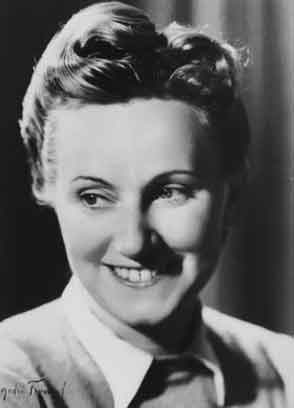
Odette Rosenstock was born in Paris on August 24, 1914 in the Sentier district, which made her forever the “Parisienne” for whom the suburbs seemed the almost unreachable end of the world. Her mother, Marthe Irma Legendre, came from a Jewish family from Lorraine which, in 1870, had opted for French nationality and settled in Paris. Her father, Camille Rosenstock, was born in Bischheim in the Bas-Rhin in 1882. Her parents ran a clothing factory, employing four or five people on site and about twenty others working from home. The family was not observant. She went to primary school, then to the Lycée Lamartine, where she passed her baccalauréat in 1933. She studied law before enrolling in the faculty of medicine.
In the early 1930s, France’s economic situation was poor, unemployment was rising, and once again the Jews were blamed. In Germany, Hitler, imprisoned in the fortress of Landsberg am Lech (Bavaria) for an attempted coup, wrote Mein Kampf during his eight months in prison. He won the elections in 1933. The world economy was deteriorating and France did not escape a rising tide of deep discontent. Odette, a secular young woman, felt much more concerned by her Jewishness. She had to face the hostile reactions that were being expressed more and more strongly, especially since the victory of National Socialism in Germany in 1933.
A wholehearted, passionate teenager, outraged by injustice, Odette did not belong to any political party, but she discreetly attended debates and meetings. The hostile atmosphere gave her the necessary sense of the group, of the importance of “sticking together”. Without having been religious, she recognised herself in the rigour and the demands of Judaism.
At the end of the Spanish Civil War in 1938, Odette went to the Pyrenees with the Centrale Sanitaire to receive Spanish Republican refugees from the war, and witnessed the opening of the first internment camps, in particular Rivesaltes, Argelès and Perpignan. She took part in some clandestine operations, getting refugees out of the camp in ambulances, taking them to hospitals and giving them first aid. The camps were guarded by Senegalese riflemen, but Odette, on a mission, did not hesitate to slip past them with no other weapon than a white coat in her hand, which she would use to get the designated person out of the camp.
Back in Paris, she completed her medical studies with a diploma in hygiene and prevention and presented her medical thesis under the supervision of Professor Tanon: “Notes on toys and the protection of children”. A year later, she worked as a locum for several general practitioners.
In December 1939, Odette met Moussa Abadi in Paris at the home of Olga, a friend of Odette’s who was also a doctor.
Starting her working life, Odette stood in for a doctor in Vanves and another in Condé-en-Brie. She was appointed Social Security Medical Inspector at the evacuation centres for Paris schoolchildren until May 1940, then Medical Inspector of schools in the Loiret, in Montargis, where the anti-Jewish laws caught up with her and excluded her from her profession on October 3, 1940. Back in Paris, Odette worked on a sessional basis in Jewish clinics, mainly treating foreign nationals. Later, these clinics were closed because they were considered dangerous for those who used them.
At the end of November 1942, Odette joined Moussa, who had taken refuge in Nice, and worked as a doctor in a clinic of the O.S.E. (Œuvre de Secours aux Enfants, the Children’s Relief Organisation). There she met a young woman doctor who was planning to leave Nice and who decided to show Odette how the clinic worked so that she could replace her – which she did, on the morning the doctor no longer came. Although she was in the Italian zone, Odette was aware of the danger and of how precarious her situation was. It was in this tense atmosphere, in the first half of 1943, that Moussa met Father Penitenti, chaplain to the Italian troops based in Eastern Europe. This meeting was decisive in making them aware of the danger to come and in the action Moussa and Odette decided to take: organising the rescue of Jewish children.
This was the beginning of the Marcel network.
It was also in September 1943 that Simone and Madame Rosenstock (Odette’s sister and mother) were arrested on the demarcation line while trying to join their father and husband in the free zone.
Monsignor Rémond provided cover for Odette (renamed Sylvie Delattre) by putting her in charge, as a social worker, of the children cared for by the diocese’s charities.
On April 25, 1944, after being denounced, Odette was arrested at her home in Nice by the Milice (a corps of French volunteers formed to fight the maquis under the German occupation). She was interrogated at the Hôtel Excelsior, then at the Hôtel Hermitage, where the interrogations were by turns brutal and almost friendly, promising freedom in exchange for information. Despite torture, Odette said nothing about “Monsieur Marcel” or the hidden children. To protect Monsignor Rémond, she confessed that she had deceived him about her identity. After the war, a telegram was found in the German police archives from SS Captain Dr Keil of the Nice Gestapo, asking Brunner, the commandant of the Drancy camp, to resume the interrogation of the Jewish woman “Rosenstock”.
She left Nice on May 2 for Drancy, which had become the assembly camp for arrested Jews before their deportation. Put in charge of convoy no. 74, she was then deported with 1,200 people to Auschwitz-Birkenau. After a three-day exhausting journey, amid the orders shouted by the SS, Odette entered the camp and became prisoner number A05598. Not everyone had this “luck”: many were sent straight to the gas chambers and crematoria. Appointed doctor of the Revier (the camp “infirmary”) under the authority of the terrifying Mengele, she tried, with the few medical means at her disposal, to relieve the suffering of her fellow prisoners.
In November 1944, as the Red Army advanced, the Nazis evacuated the camp to Bergen-Belsen. The deportees’ health was in a terrible state: Odette struggled to recover from the typhus she had contracted. Bergen-Belsen was liberated by the British on April 15, 1945 and Odette was repatriated.
From the end of June 1945 to the beginning of 1948, Odette worked again as a doctor alongside Moussa at the O.S.E. clinic in Nice, which he had founded and which he ran as head of medical and social work.
Odette returned to Paris in 1948. A sessional Medical Inspector of schools in the 12th arrondissement, she then became head of department at the City of Paris hygiene laboratory from 1952 to 1956.
Odette and Moussa married on November 3, 1959 at the town hall of the 12th arrondissement. Rabbi Farhi married them religiously on November 21, 1989.
Until 1978, Odette was Deputy Medical Inspector at the Directorate-General for Health and Social Action of the Préfecture de la Seine. She then became Chief Medical Officer of the venereology department of the Paris Directorate for Health and Social Action until her retirement in September 1979. Always concerned for children, Odette practised medicine as a volunteer, even after her retirement, at the Collège and Lycée Morvan in Paris (a school for the hearing impaired).
Between 1960 and 1980, Odette shared Moussa’s passion for the theatre and went with him to performances every evening.
In 1995, she published “Terre de Détresse” with L’Harmattan. It took her more than forty years to write this magnificent and terrible testimony of her experience of the camps. She remained marked by it forever, and in this book she writes: “So, for us, the survivors of Bergen-Belsen returning to France, a journey of about eight days was all it took to tear us away from our camp and throw us back into the melting pot of other people’s lives, the ‘normal people’?….. The survivors had to learn to breathe again on the planet of ‘before’ – before exile, before our destruction – the one where people sing of beauty, justice and love…. Will we ever stop madly believing that we have come back only for a while and that everything could start again? Whatever the place, whatever the day and the hour, amid the worries and joys of our ordinary lives, how can we not suddenly be overwhelmed by our old, unyielding anguish, which screams that we are once again in the place, on the day and at the hour when we must once more abandon everything, let ourselves be swept away by the storm and find again the mad planet of our camps, the one to which we belong forever?”
Moussa died on September 15, 1997.
Having accomplished the task she had set herself of preserving Moussa’s memory, she decided to join him on July 29, 1999. Before leaving, Odette Rosenstock took care to write a letter to those close to her to express her gratitude.
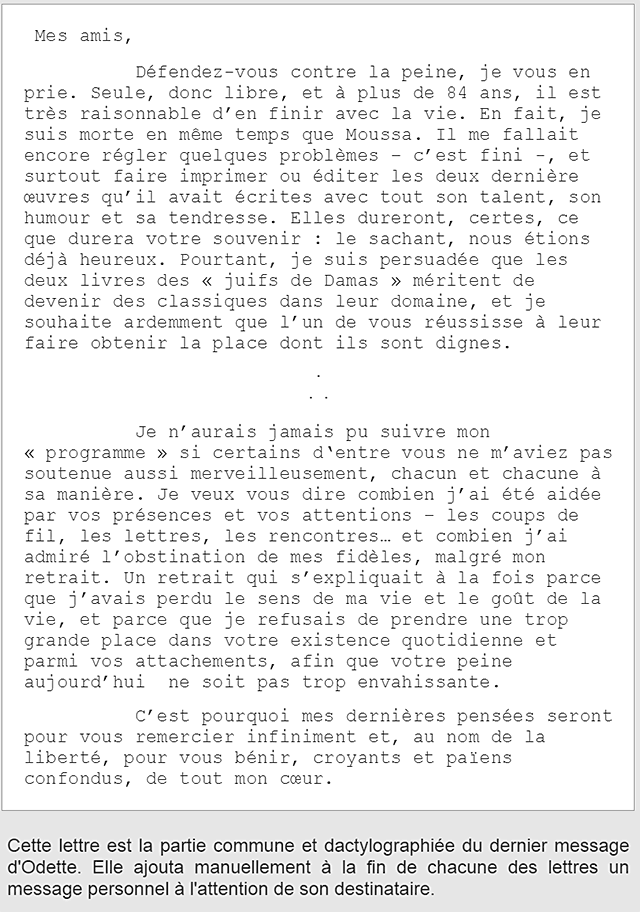
Odette’s last letter
Bibliography
 Terre de détresse
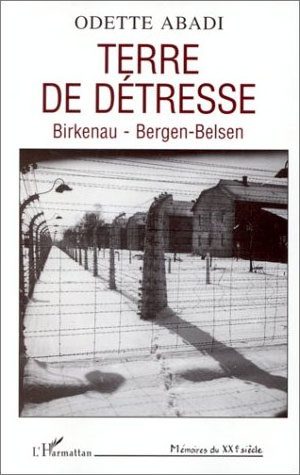
Publisher: L’Harmattan
With lucidity, Odette Abadi depicts, in those black holes of death that were Auschwitz and Bergen-Belsen, the behaviour of the men and women she met, and the courage and devotion of some of her fellow prisoners. Arrested on April 25, 1944 and handed over to the Gestapo, she was transferred to Drancy and deported to Auschwitz on May 20, 1944. Odette Abadi first wrote this account on her return from deportation, then revised and completed it at the end of her life for publication in 1995.
> Buy: www.fnac.com | www.amazon.fr
Honours
Silver Medal for Epidemics, January 1947
Resistance Medal, March 1947
Medal of French Gratitude, June 1947
Silver Medal of the Académie Nationale de Médecine, April 1980
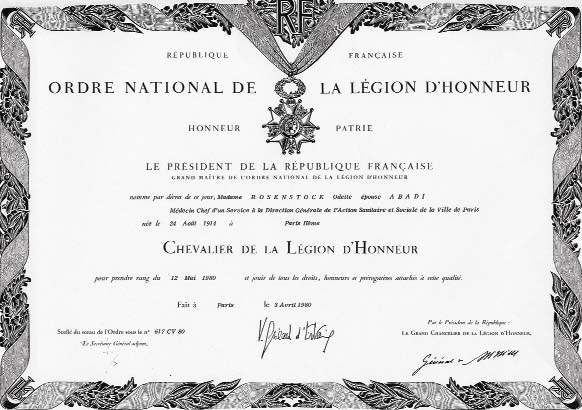
Legion of Honour, May 1980
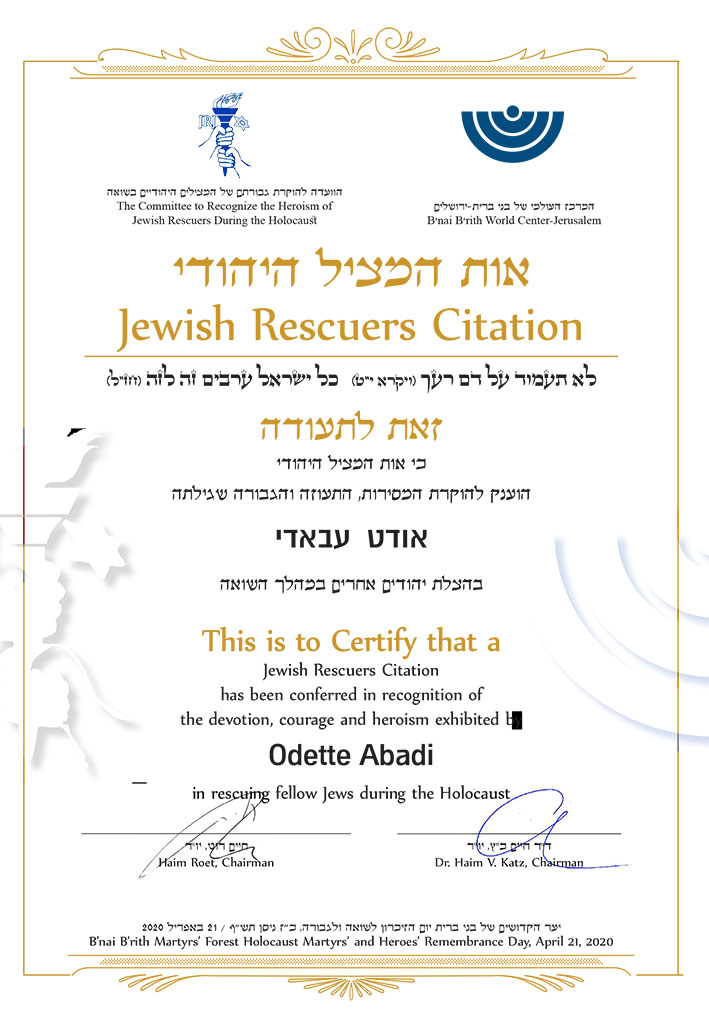
“Jewish Rescuer” citation in April 2020 (see the ceremony)