Monsignor Paul Rémond
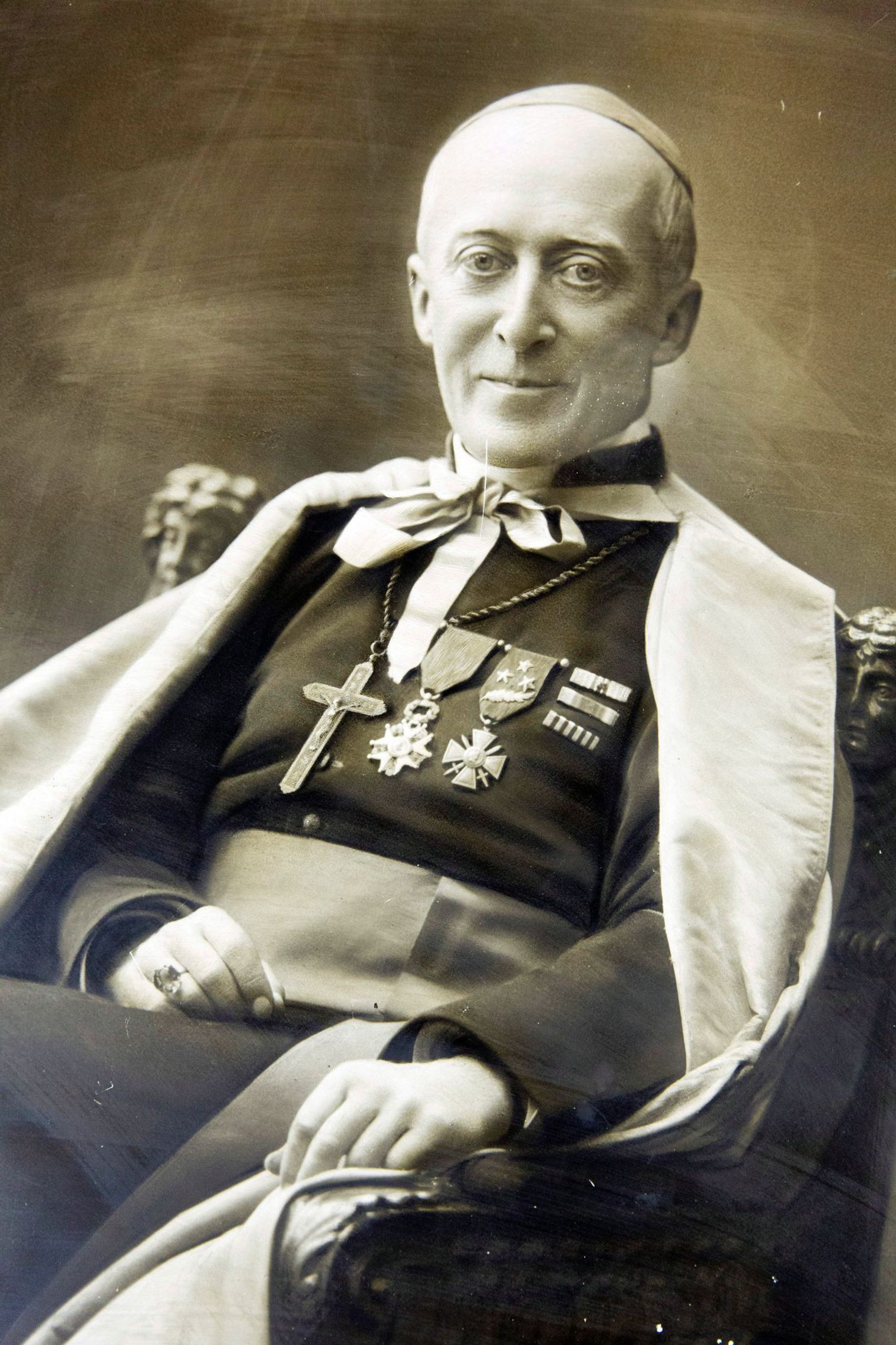
The eldest of seven children, Paul Jules Narcisse was born in Salins on September 24, 1873. His father, Jules Rémond, born in Clairvaux-les-Lacs in 1841, set up as a notary in Besançon in 1880. His mother, born in Salins in 1828, was a second cousin of Pasteur.
After secondary school at the Marianist Brothers’ Institution Saint-Jean in Besançon, he enrolled after the baccalauréat at the University of Besançon, from which he graduated in 1894 with a degree in Letters. He spent a year at the University of Freiburg im Breisgau to improve his German. In 1895, at the age of 22, he entered the French Seminary in Rome. In 1899, he obtained a doctorate in the philosophy of St Thomas.
On July 30, 1899, he was ordained priest in Besançon by Monsignor Fulbert Petit, archbishop of the diocese, and on August 3 he celebrated his first Mass in the church in Salins where his parents had married and where he had been baptised. From August 1900, and for six years, he was curate of the parish of Saint-Christophe in Belfort, in contact with the republican-minded Archbishop of Besançon, Monsignor Fulbert Petit. In 1906, he became chaplain of the Lycée Victor Hugo in Besançon and distinguished himself through social work with pupils of all faiths, winning everyone’s approval. In May 1914, he was appointed honorary canon of Besançon cathedral.
Canon Rémond was mobilised on August 2, 1914 as a lieutenant in the territorial infantry, with the 7th Army Corps. He saw action in November on the Aisne front. In 1915, he was promoted to captain. In January 1916 he first went to Verdun, then in August 1916, at the head of a company of armoured machine-gun and cannon cars, to the Somme front. His heroic conduct earned him another mention in army dispatches, the rank of major and the Legion of Honour. From the end of 1916 to October 14, 1918, he took part in the battles of the Argonne, Champagne, Verdun (for the second time), Lorraine and the Somme. With his battalion, he defended Roeselare (West Flanders). On November 11, 1918, having crossed the German border, he was appointed commander of the district of Eupen, near Aachen.
The Treaty of Versailles gave France a temporary zone of occupation on the left bank of the Rhine. The Rhinelanders were mostly Catholic, so a man was needed who could build links with the local clergy that would benefit France, in order to counter German influence at the Vatican. A decree in the Journal Officiel of May 14, 1921 announced the creation of the post of bishop and chaplain-general of the Army of the Rhine. On May 29, 1921, he was consecrated bishop in Besançon cathedral and became chaplain inspector-general in the Rhineland, which in 1923–1924 represented some forty French parishes and eight German dioceses. At the same time, Monsignor Rémond was given jurisdiction over Syria and Lebanon, then administered by France. From April 5 to July 1, 1927, a tour of the East took him from Egypt to Jerusalem and from Syria to Lebanon.
In 1926, Pope Pius XI condemned the Action Française. Monsignor Rémond, true to his principles of generosity and openness to others, obeyed the Holy See without difficulty and disowned the Maurrassian ideas. In 1930, France withdrew from the Rhineland. On March 21, 1930, Pius XI appointed Monsignor Rémond Bishop of Nice, while leaving him his jurisdiction over the Saar until 1935 and over Syria until 1940. For thirty-three years he devoted himself entirely to the diocese of Nice, refusing any transfer, bringing modern projects for Catholics, and declaring in his first pastoral letter (Semaine religieuse, July 13, 1930): “I come to you… with the sole desire to lift up, relieve and console those who toil and those who suffer, to teach the ignorant, to defend the oppressed…”
From 1933 to 1939, he took a stand in many writings and homilies on the international crisis, both economic and moral, denouncing people’s desire to get rich quickly, their lack of scruples, and the spread of dishonesty and selfishness. But his deepest concern lay in his analysis of the rise of Nazism and his condemnation of the first anti-Jewish measures taken by Hitler as soon as he came to power in January 1933. Monsignor Rémond took a public stand in a sermon delivered on April 9, 1933 in the Church of the Sacred Heart, in which he condemned “persecution on religious grounds”. He expressed to the Jewish community his “sorrowful sympathy” and stated “his desire to ease their suffering and to help them morally and materially”.
He gave his support to several Jewish defence and mutual aid groups. In particular, he supported a public meeting organised by Bernard Lecache (President of the International League against Antisemitism) by sending a representative.
Like most bishops, Monsignor Rémond rallied to Pétain in July 1940, but he never supported collaboration and did not submit to the other leaders of Vichy. His last public statement of loyalty to the Marshal dates from September 22, 1942, a joint text with the bishops of Aix-en-Provence, Fréjus and Monaco. His silences became eloquent, and his occasional initiatives to help opponents of the regime, although discreet, were many. In May 1940, he visited the internment camps for foreign Jews and obtained the release of a number of them. He condemned the Italian occupation between November 1942 and September 1943, and when the Italian troops entered Nice, he raised the French flag over the bishop’s residence.
In the first half of 1943, he met Moussa Abadi and agreed to help him save children by providing, at the bishop’s residence, a base for the Marcel network.
Outraged by the presence of the occupier and by the persecution of the Jews, he gave unfailing support to the rescue of hunted children, regardless of the real danger to himself. He encouraged the priests involved in the Resistance, warning them when they were in danger, and intervened with the Germans when the resistance fighters Torrin and Grassi were hanged on avenue de la Victoire, demanding that the authorities take them down.
The main towns on the coast were liberated at the end of August 1944. Monsignor Rémond, whose actions were becoming more and more widely known, enjoyed great popularity among the population. He took part in many patriotic, religious and civic ceremonies, alongside the military authorities and representatives of the Protestant and Jewish communities. “…he saw himself as the representative of moral values… he did not hesitate to take risks for the victims of barbarity…” (Ralph Schor, in his book Monseigneur Paul Rémond).
Monsignor Rémond died on Wednesday, April 24, 1963.
Honours
Legion of Honour
Croix de Guerre with palms, 2 silver stars and 2 gold stars
Officer’s Cross of the Order of Leopold
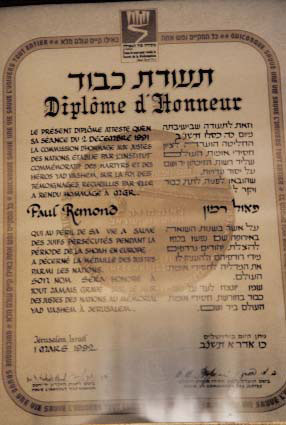
Righteous Among the Nations medal, awarded by Yad Vashem