Pastor Pierre Gagnier
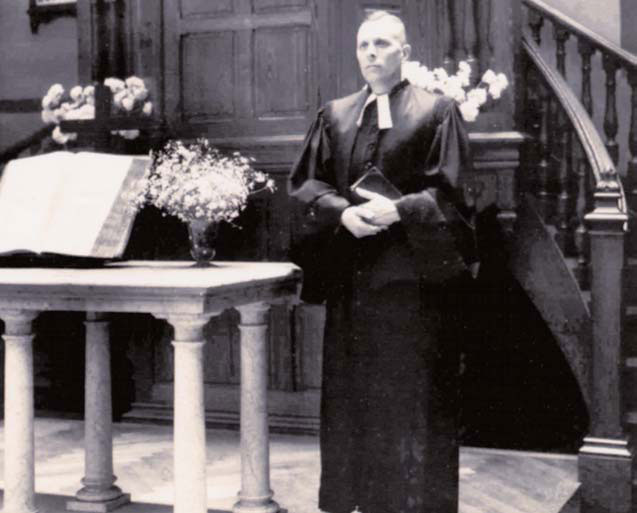
Pierre Gagnier was born on December 22, 1909 in Crozon, in the Finistère, to Paul Victor Gagnier and Hélène Marie Couchard, both originally from the Charente.
A good pupil, he passed his baccalauréat at the lycée in Angers, where his family had moved. It was at the Lycée Lakanal in Sceaux (92), in the preparatory classes for the literary grandes écoles, that he discovered Scouting, from which many friendships were born that lasted until the end of his life. The idea of becoming a pastor began to take shape. After a year at the Sorbonne and a year in Germany, he obtained a degree in German. After his military service, he studied theology in Paris between 1931 and 1934.
For his first ministry he was appointed to Barre-des-Cévennes in the Lozère, where he met Hélène Aubanel, whom he married in 1937; they had four sons.
The war forced him to leave. He served during the “Phoney War” in Alsace as an interpreter, since he had obtained the military interpreter’s diploma during his military service. He was taken prisoner in Westphalia; during his captivity he organised “talks on the books of the Bible” and took part in sporting and cultural activities in the camp. A small Protestant community formed in the camp, where strong friendships were made.
He was released in the summer of 1941 and, on his return to France, was appointed pastor of the Reformed Church in Nice. He stayed there until 1953. During the years of occupation, this courageous man, true to his convictions and with the unfailing support of his wife, did not hesitate to hide Jews in the presbytery and in the church. The presbytery became an annexe for false papers. Pierre Gagnier took an active part in making identity cards and ration cards, found hiding places, and provided food and money. He even became an accomplice to escapes.
At this time he met Moussa Abadi, whom he called “Monsieur Maurice”. Several children of the Marcel network were hidden thanks to families approached by Pastor Gagnier. He took young Jews into his team of Rover Scouts. His knowledge of German allowed him to go to the Gestapo, where he met the sinister Brunner, to obtain information when one of his own was arrested. He was not afraid to go to the Kommandantur to express his outrage when resistance fighters had been hanged from the lampposts of avenue de la Victoire. Nor was he afraid to ask an official of the Commissariat for Jewish Affairs, who had come to question him about the false baptism certificates he was issuing, whether he was not ashamed of the job he was doing. This attitude made him enemies within the Presbyteral Council, one influential member of which accused him of “taking sides against the government”.
After the war, he served in the parish of Passy in Paris from 1953 to 1967. He was Vice-President of the National Council of the Reformed Church of France from 1959 to 1962.
In 1967, he was appointed to Le Chambon-sur-Lignon, where he became head of the Collège Cévenol International until 1970. During the 1967–68 school year, marked by the student protests of 1968, he showed a remarkable capacity for dialogue and worked to modernise the school. A true communicator, insatiable when it came to debate, he succeeded in bringing the pupils together around constructive reforms.
He took part in many synods and international conferences. He was given various responsibilities, including the chairmanship of the Catechesis Commission of the Reformed Church of France, which he held for several years.
No, hell is not other people: what makes a life worthwhile is the people it has met.
Deeply devoted to his vocation as a pastor, he wanted his commitment to the Church, whose rigidity he rejected, to be in tune with its time. Ecumenism, in particular, was one of his concerns. These years of ministry were an opportunity to form very deep friendships. In the book “Cinquante ans de rencontres” (Fifty years of encounters), which he left to his eleven grandchildren, he takes the opposite view to Sartre: “No, hell is not other people: what makes a life worthwhile is the people it has met.”
During his ministry he travelled widely – Algeria, Gabon, Sweden, Germany, the United States – and had many enriching encounters, notably with Dr Schweitzer in Lambaréné, Gabon, and with Alain Bombard.
Forced to retire early for health reasons, he settled at the foot of the Cévennes in Sauve (Gard), his wife’s native village. He took the opportunity to travel (Israel, Martinique, the Seychelles) and to welcome many friends and, of course, his children and grandchildren.
He had a strong personality, forged in his family by his father, a military man, and knew how to show authority both in his parishes and in his family. He commanded respect and good sense. Friends and family did not hesitate to ask his advice.
Very discreet about what he did during the war, Pierre Gagnier spoke very little about that time, even to his grandchildren. In a speech on May 18, 1945, he said: “I believe that we Christians should say nothing of what God allowed us to do for our neighbours in distress. It was a privilege for us to be able to act and fight against that anti-Christian force, German racism.”
He died suddenly on June 6, 1988 and is buried in the cemetery of Générargues in the Gard.
Honours
Righteous Among the Nations medal awarded on January 18, 2012 to Pastor Gagnier and his wife.
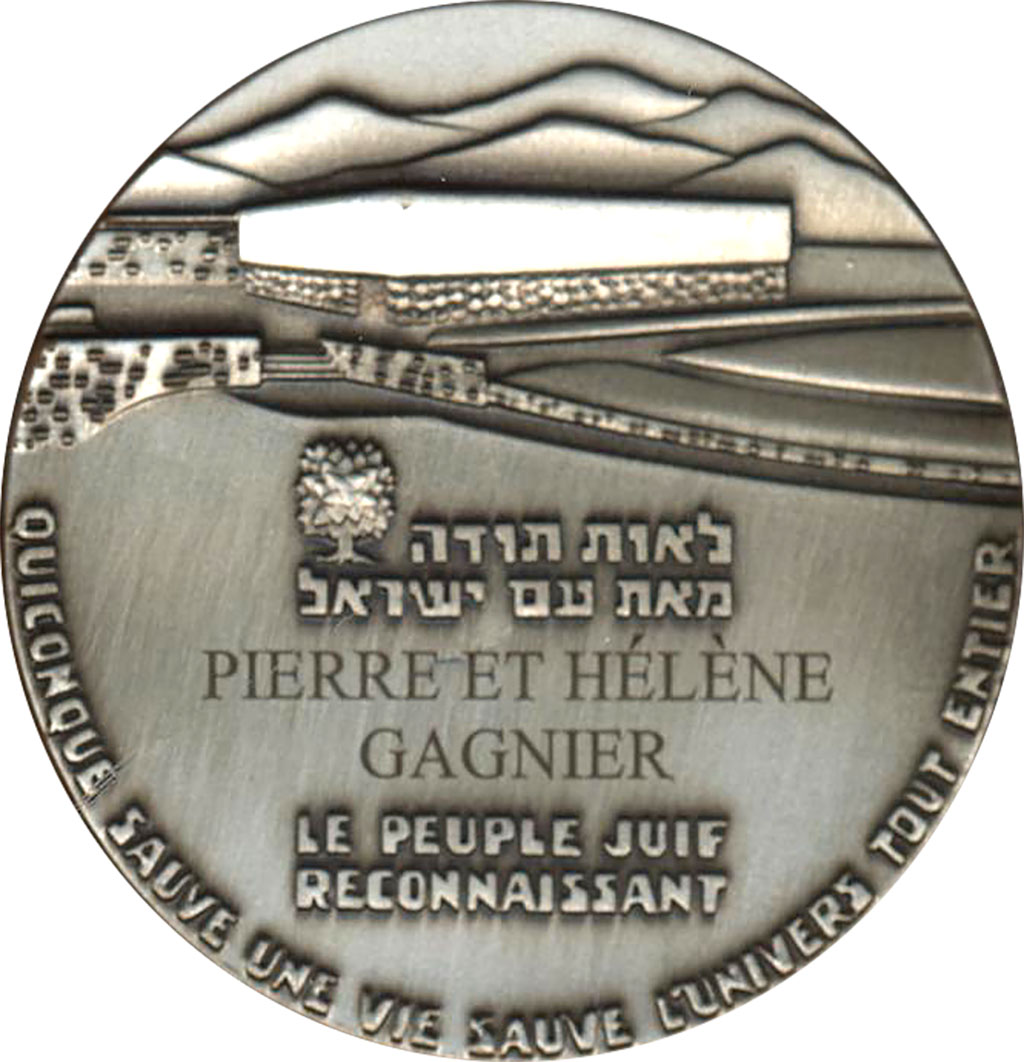
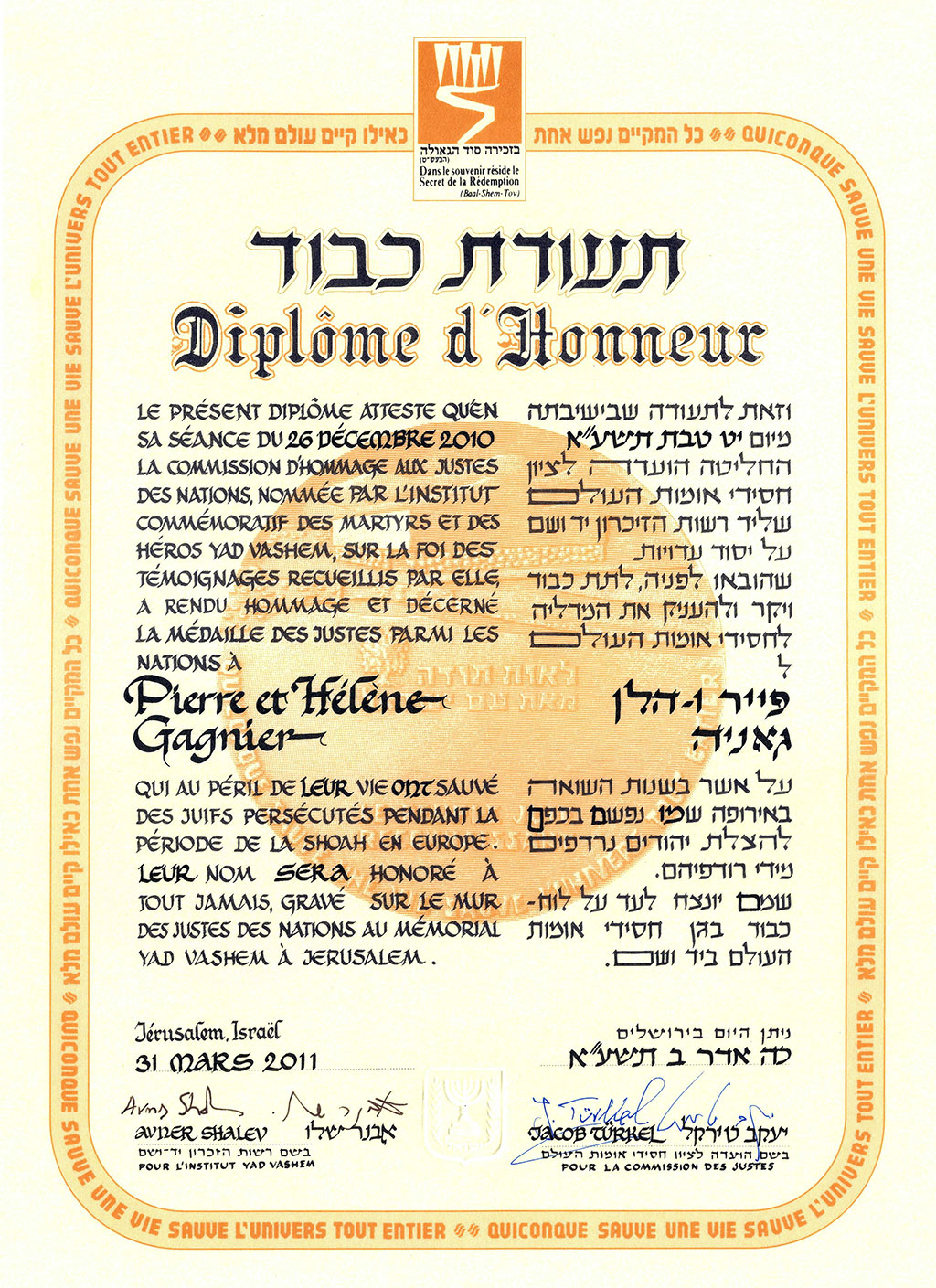
The Protestant meeting centre in Nice was named after Pierre and Hélène Gagnier on May 1, 2022