Inauguration of the “Pierre and Hélène Gagnier” Centre in Nice
May 6, 2022
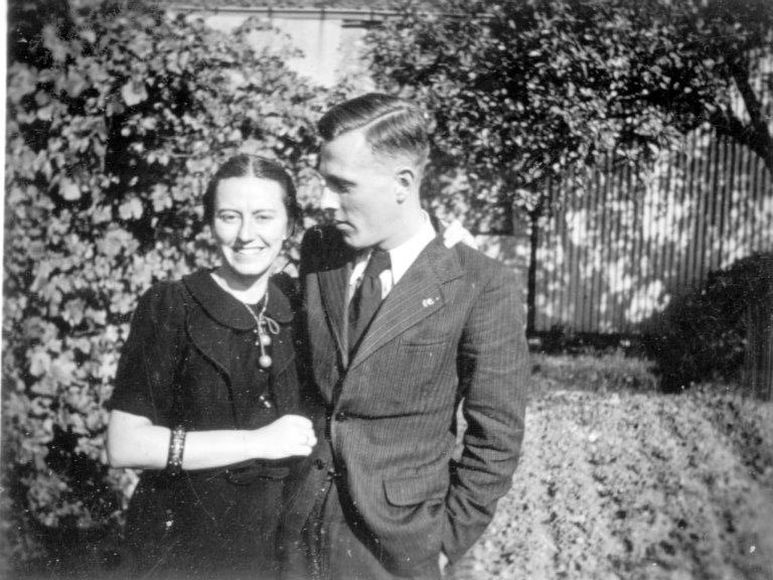
On May 1, 2022, the Protestant Meeting Centre in Nice took the name “Centre Pierre et Hélène Gagnier”.
The United Protestant Church of Nice–Saint-Esprit has always kept alive the memory of Pastor Pierre Gagnier and his wife Hélène, née Aubanel, in each of its choices and actions. Its representatives wished to pass this memory on to future generations by giving their names to the meeting centre at 19 rue Maccarani.
For the occasion, many of us gathered on Sunday, May 1 at the church on boulevard Victor Hugo. Representatives of the City of Nice, the Regional Council, religious bodies of all faiths, associations and others came together to mark the moment.
Pierre and Hélène Gagnier contributed to the work of the Marcel network, which saved 527 Jewish children during the Second World War. They were able to act because they were in Nice between 1941 and 1953, when Pastor Pierre Gagnier served as minister of the Reformed Church of Nice. It was for all his work during this period that the Protestant Church of Nice wished to honour his memory by giving his name to the meeting centre. His wife Hélène is naturally associated with it, as she was by his side throughout his life and gave him active and unconditional support.
The ceremony took place in two parts. The first brought everyone together inside the church to hear speeches by the United Protestant Church of Nice, the Gagnier family, the association Les Enfants et Amis Abadi and the City of Nice. The second part took place outside, in front of the Protestant meeting centre.
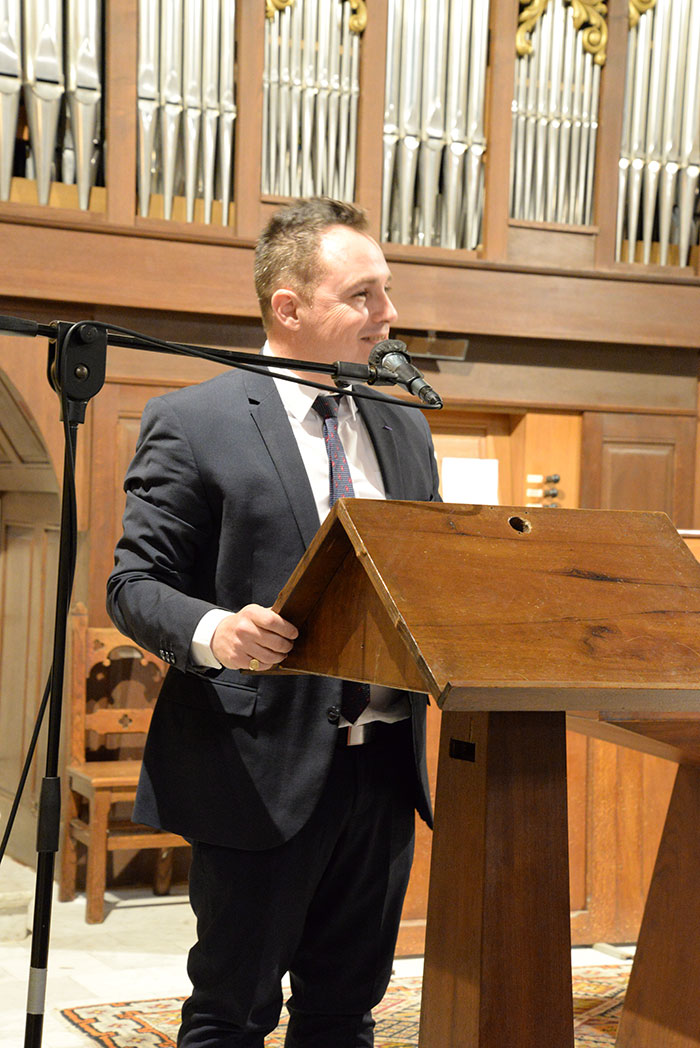
Julien Giraud-Destefanis, President of the United Protestant Church of Nice, opened the ceremony with a moving tribute recalling the Gagniers’ work within the Church.
 Madam Deputy Mayor for Religious Affairs and for the Cœur de Nice district, representing Monsieur Christian Estrosi, Mayor of Nice and President of the Nice Côte d’Azur Metropolis,
Dear Isabelle Visentin,
Vice-President of the Provence-Alpes-Côte d’Azur-Corsica Regional Council of the United Protestant Church of France,
Dear Pastor Christian Barbéry,
President of the Presbyteral Council of the United Protestant Church of the Transfiguration,
Dear Chantal Aime,
Head of the FPF 06 (Protestant Federation of France, Alpes-Maritimes),
Monsieur Bernard Kohl,
President of the Entraide Protestante de Nice and Treasurer of the Fondation de l’Asile Évangélique de Nice,
Dear Christine Jacob,
Leader of the Cubs and Protestant Scouts and Guides of Nice,
Dear Christelle Danzin,
President of the Jewish Consistory of Nice,
Dear Maurice Niddam,
Rabbis,
Episcopal Delegate, representing the Bishop of Nice,
Dear Canon Philippe Asso,
Dear colleagues of Alpes-Maritimes-Fraternité,
President of the Enfants et Amis Abadi,
Dear Madame Andrée Poch-Karsenti,
President of the Yad Vashem Committee Nice-Côte d’Azur,
Dear Monsieur Daniel Wancier,
President of the Association for the Memory of the Jewish Children
Deported from the Alpes-Maritimes,
Dear Madame Michèle Merowka,
Dearest Gagnier family,
Dear pastors of the Nice churches that are members of the FPF and of the United Protestant Church of Nice-Saint-Esprit,
Dear members of the community,
Dear friends,
Dear children,
“That which we have heard
and known,
and our fathers have told us,
we will not hide them from their children,
shewing to the generation to come.”
Today these words of Psalm 78 resonate especially in our hearts. Yes, our fathers have told us. They told us about the world they knew, they told us about absolute evil, they told us about unspeakable horror.
Our fathers told us about the war, they told us about the systematic extermination of our Jewish sisters and brothers, they told us about Nice in 1943.
Pastor Pierre Gagnier and his wife Hélène had been in our parish for two years. Pierre ministered in our Reformed community, which at that time was on boulevard Dubouchage. The Italian troops withdrew and gave way to the German occupation. Many French Jews and Jews from other European countries had come to take refuge in Nice alongside a Jewish community that had been at home there for centuries, in a city that until then had been relatively spared by Nazism and by French collaboration. Alois Brunner, commandant of the Drancy camp, was given the task of carrying out, with the help of the militias of the French State, the deportation of Jewish families to the extermination camps. 2,500 Jews were deported in the space of three months. Few came back.
Very soon, many understood their duty to resist absolute evil. The Marcel network was then organised around Moussa Abadi and Odette Rosenstock, with Pastor Gagnier and his wife Hélène, with the pastor of the Baptist Church, Edmond Évrard, his wife and his sons, and with Mgr Rémond, Bishop of Nice. 527 children were saved.
As early as March 1939, six months before the outbreak of war, the Reformed Church of France had prepared itself for spiritual resistance. André Trocmé, pastor of Le Chambon-sur-Lignon, the village of the Righteous, had already written to the Reformed consistories: “You shall love the stranger, for you were strangers in the land of Egypt. This exhortation addressed to the Israelites in Deuteronomy 10:19 is striking in how topical it is; it strikes us especially, we Reformed Christians, descendants, at least spiritually, of the Huguenots hunted down in the 17th and 18th centuries.”
With the Marcel network, Pierre and Hélène Gagnier took every risk, bringing together the Christian institutions, communities and Protestant families willing to hide children.
They did, however, meet with disagreement from some members of the Presbyteral Council, frightened that a pastor should openly oppose the policy of the French State. They certainly did not know the details of the terrible fate awaiting the Jews, but neither did they understand that when the lives of children, men and women are at stake – and when extremism still makes itself heard today – one cannot simply seek political compromise with evil.
Pierre and Hélène Gagnier, helped by parishioners who remain anonymous today, organised hiding places and the evacuation of children to the hinterland and to Sauve, in Hélène’s family home. They provided false baptism certificates and, with the Cimade, set up a printing press in the presbytery to make false papers. They took young Jews into the Scouts and the Rover Scouts. When a young Rover was arrested, the pastor, who spoke German, went to the Hôtel Scribe, said a word to the sentry, gave a Nazi salute, and was later seen leaving with the young man. At the Kommandantur, Pastor Gagnier, a man of strong character, expressed his outrage several times, even asking a French official of the Commissariat for Jewish Affairs whether he was not ashamed of what he was doing. He also protested publicly against the hanging of Séraphin Torrin and Ange Grassi, our two “angels of Nice”, an episode that deeply traumatised our city.
Pierre and Hélène braved every risk, and many anecdotes could tell of their heroism.
But of all this, our fathers told us little. We know all this from the testimonies of the children they saved and of their companions in the Resistance.
For Pierre and Hélène Gagnier did not wish to bear witness to their heroism, going as far as refusing all honours during their lifetime. “We Christians should say nothing of what God allowed us to do for our neighbours in distress. It was a privilege for us to be able to act and fight against that anti-Christian force, German racism.”
Yet in remembering our pastor and his wife today, we do remember. We remember the 6 million victims of Nazi barbarity. We celebrate every life saved. We express our gratitude to our pastor and his wife, and we pay tribute to all the anonymous members of our community who contributed to the work of Pierre and Hélène Gagnier. We remember the privilege of being able to act with the help of the Lord.
For today our generation inherits this memory of the Righteous, a living memory. Today the memory of Pierre and Hélène Gagnier lives on in our concrete actions, through the commitment of our Church, a community open to all and attentive, at the heart of the city, to fraternity, to living and acting together. The work of Pierre Gagnier lives on today: in 1943 he founded the Entraide Protestante de Nice (Protestant mutual aid service), which is still active today and which served as cover for his resistance activities.
We receive this rediscovered memory together with the Gagnier family, whom we sincerely thank for their support in our decision to name our diaconal centre after their parents. This memory that we share does not lie only in heroic deeds, but in the faith that inspired Pierre and Hélène, the faith which means that, amid evil and horror, we are called to show the presence of the Lord in the midst of the powers of death. A memory that keeps us active, at a time when the sound of marching boots is heard again in Europe, and when, all over the world, children and adults still suffer the degrading treatment of slavery and face the worst dangers to come and knock on our doors. A memory that takes on its full meaning today through the work of the Entraide Protestante de Nice, which Pastor Gagnier founded for his diaconal work and which has continued ever since, welcoming people in social difficulty and refugees. Today, by giving our diaconal centre the name of Pierre and Hélène Gagnier, we continue their commitment by opening wide the doors of our house to the city, as they did – a house without pretension or beauty, but where everyone will find a haven of peace, a place of fraternity and safety. We remember our duty to welcome, and it is through the witness of Pierre and Hélène’s faith, and the silent preaching they continue to proclaim through their actions, that we remain attentive to all refugees, in this centre which today is devoted to welcoming Ukrainian refugees. Dedicated to all our diaconal activities, to welcoming people in hardship and refugees, and to welcoming churches from every continent, the Centre Pierre et Hélène Gagnier is meant to remain a place where our community commits itself to everyone. At present, nearly 200 Ukrainian families a week are welcomed in this centre by our parishioners and the volunteers of the Entraide, continuing what Pierre and Hélène Gagnier wished to bear witness to.
For we will always remain the flock shepherded by Pastor Gagnier whenever we remember the privilege of being able to act against all anti-Christian forces, even if it means risking one’s reputation, and even one’s life. We will remain the spiritual heirs of Pierre and Hélène Gagnier whenever we keep our doors wide open to the refugee, the hungry and the hunted, wherever they come from. We will follow in their footsteps whenever we remember the victims of the Shoah and fight so that, nowhere in the world, it may ever happen again. With Pierre and Hélène Gagnier, we will remain Protestants whenever we feel deep revulsion against all forms of intolerance, against racism, antisemitism and xenophobia, and when we must once again denounce the temptations of extremist and Holocaust-denying discourse in our country. We will remain Christians whenever we pay attention to the sacredness of every human life. Finally, we will remain human whenever, with our sisters and brothers from all horizons, we keep faith in humanity and in future generations, so that one day, with God’s help, there will be no more need for an Entraide Protestante or for a Centre Pierre et Hélène Gagnier.
Julien Giraud-Destefanis
President of the United Protestant Church of Nice-Saint-Esprit
Emmanuel Gagnier, grandson of Pierre and Hélène Gagnier and Secretary General of the association Les Enfants et Amis Abadi, then spoke to describe with great accuracy the selflessness of his grandparents.
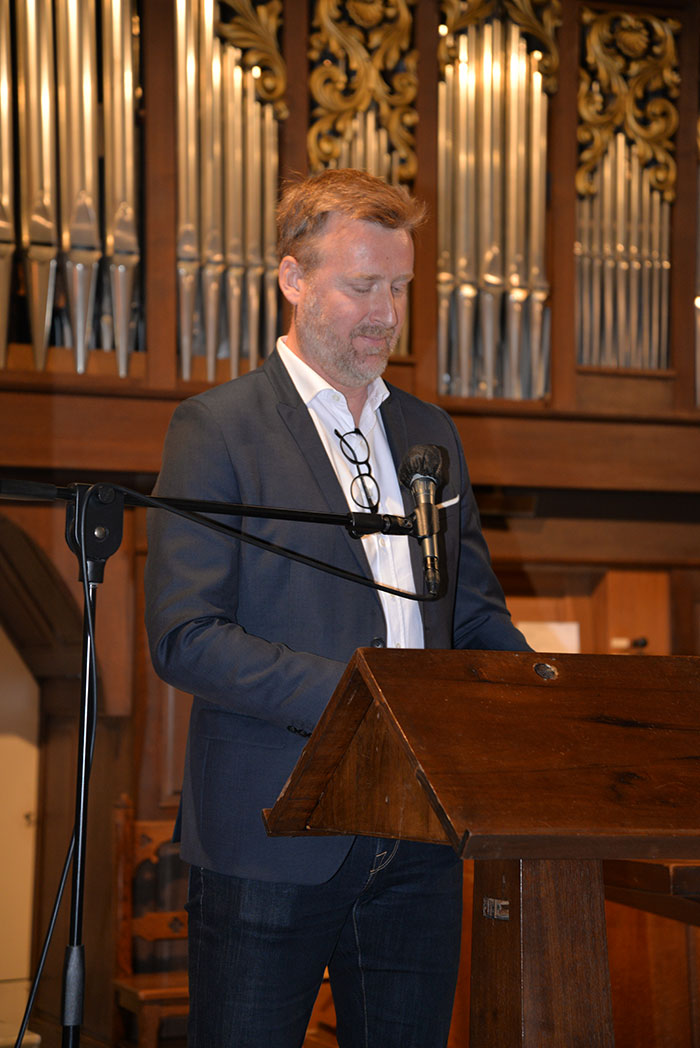 On behalf of the Gagnier family and of the association Les Enfants et Amis Abadi, thank you for being here today. First of all, I also want to thank the United Protestant Church of Nice for thinking of my grandparents, Pierre and Hélène Gagnier, when the question arose of what name to put above its door.
But this question raised another one within our family: should we agree to have our grandparents’ name written in large letters on a building? If we had asked them during their lifetime, they would very probably have refused, just as they would have refused the Righteous Among the Nations medal.
We all have in mind this sentence spoken by my grandfather, which we love to repeat excessively, so much does the panache we give it flatter our family ego – I quote: “I believe that we Christians should say nothing of what God allowed us to do for our neighbours in distress. It was a privilege for us to be able to act and fight against that anti-Christian force, German racism” – end of quote. And I won’t even mention my grandmother’s humility and discretion.
This wish to say nothing makes their action even nobler. They say that a true gift is anonymous. And it’s true! I recently read a short story of the kind you see on social media. It is the story of a father who says to his son: “Son, when night has fallen, go and quietly leave this sack of grain in front of the house of the needy family at the end of the street.” The son asks: “But Dad, wouldn’t it be better simply to knock on their door now and give it to them?” And his father replies: “No, because, you see, this way they won’t know who left the sack. And the next day, when they walk through the village, every person they meet will be their potential benefactor. That is how we build bonds and cultivate solidarity, without taking away the dignity of those who have less.” I don’t know if the story is true, but it shows how the anonymity of a gift extends its value beyond those who received it.
So, to come back to the discussions in our family when we had to decide whether to accept the application for the Righteous medal: we thought about it a great deal and finally agreed. Not for the sake of the tribute paid to my grandparents, and even less for any kind of glorification, but for the sake of memory and of passing it on. We thought that what they had done within the Marcel network could inspire other people. We told ourselves that if the memory of what they had done could make even one person want to reach out to those who need it, then the story had to be told. It had to be told how History is also made of solidarity and selflessness.
The same question therefore arose about putting their name on this building today. And the same answer was given, in recognition of everything they did within this Church here in Nice between 1941 and 1953, including founding the parish’s mutual aid service. So thank you – not for my grandparents, but for all the people who may perhaps be helped because their memory will have inspired others. Let us never forget that History repeats itself relentlessly, even if it changes its costume. We can all open our door to those who no longer have a roof, to those who are persecuted, whether Jewish, Christian, Muslim… Ukrainian.
As a pastor, my grandfather strove constantly to work in an ecumenical spirit. He did not like barriers between minds. So let us hope that their name on this centre will help to keep bringing barriers down.
Thank you
Emmanuel Gagnier
Grandson of Pierre and Hélène Gagnier
Secretary General of the association Les Enfants et Amis Abadi
On behalf of Daniel Wancier, President of the Yad Vashem Committee Nice-Côte d’Azur, Emmanuel Gagnier then read a summary of the work of the Marcel network and of his grandparents, recalling the value of the Righteous Among the Nations medal awarded by Yad Vashem.
[…] In particular, he offered them refuge in his presbytery, where false papers and food coupons were also made. He also asked Protestant families to take in children of the Marcel network, and did not hesitate to go to the Kommandantur to express his outrage.
In the early days of the Occupation, the Isserlis family took refuge in Nice. The eldest sister, a non-resident medical student, stayed in Paris but was arrested in July 1942 and deported to Auschwitz. When the situation in Nice became too dangerous, Georges’s parents decided to leave the city for the village of Raphèle-lès-Arles, in the Bouches-du-Rhône. Georges, who had to finish his studies, stayed in Nice with a family friend under the protection of the Gagniers. In September 1943, Georges was arrested by the Gestapo as he was about to deliver a bag of false identity and ration cards to the OSE. While being transferred from Nice to Drancy, he managed to escape from the train and reach Pastor Gagnier, who took him to his parents’ hiding place, where he stayed until the Liberation.
From October 1943, the Gagniers employed Denise Kont, a young Jewish woman who had been living in Nice with her family since 1940, as an au pair. She was welcomed, hidden, fed and comforted in their home until the Liberation.
The Gagniers played a crucial role in rescuing many other Jews who had taken refuge in Nice and the surrounding area, such as the children Michel and Françoise Picard.
They were well aware of the danger to which they were exposing their whole family, having four children of their own, but they acted out of the deep conviction that it was the right thing to do.
Pastor Gagnier was also a leader of the Éclaireurs Unionistes de France (Protestant Scouts) and, in this capacity, offered his help to many Jews, among them young Georges Isserlis, whose family came from Russia.
The testimonies
“Why testify so late? I realise that I am one of those who lived through the upheavals of years which, I hope, will never return. My generation is dying out, and I did not want to die without having testified about that time and about what the Nazis inflicted on millions of human beings, Jews among others, and without showing that beside the executioners there were also heroes – charitable, humane and courageous people – who did not hesitate to risk their lives to save or try to save other lives, other human beings who were suffering.” – Georges ISSERLIS
“It was only after the Liberation that I learnt a little about Pastor Gagnier’s clandestine activities. During the Occupation, the rule was to ask no questions – the less you knew, the better.
When I think of that period, 1943–1944, I cannot separate Pierre and Hélène Gagnier. Their roles were not the same, but their commitment was, and the risks they took were identical.” – Denise ROUIRE-KONT
On December 26, 2010, the Yad Vashem Institute in Jerusalem awarded Pastor Gagnier and his wife Hélène the title of Righteous Among the Nations (file 11720).
Finally, Isabelle Visentin, Deputy Mayor for Religious Affairs and for the Cœur de Nice district, representing Monsieur Christian Estrosi, Mayor of Nice and President of the Nice Côte d’Azur Metropolis, gave a speech recalling the duty of remembrance to which the City of Nice is committed.
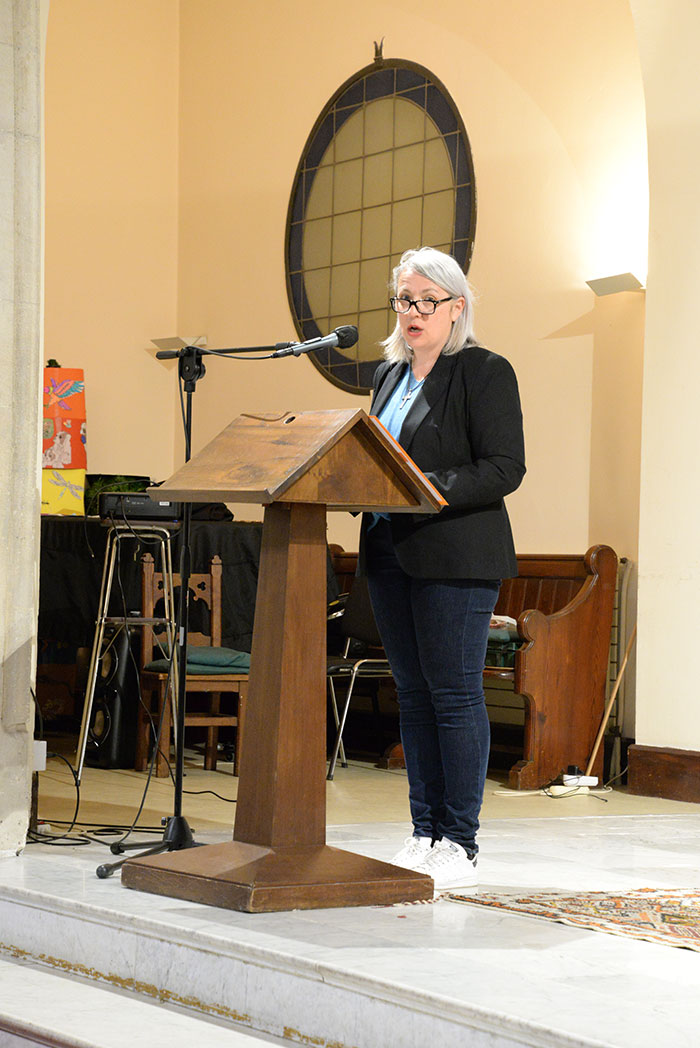 Ladies and gentlemen,
Dear friends,
It is often said that it is easier to do one’s duty than to know what it is. For Pierre and Hélène Gagnier, whose memory we honour today, there was no need to think it over or weigh up the risks. There was only a categorical imperative: to do their duty because it was their duty!
For us, who have the good fortune and privilege of living in a democratic country, there is, beyond striving for responsible and humane behaviour in our daily lives, a burning obligation: to ensure that the memory of those who suffered from the madness of men, from authoritarian regimes or deadly ideologies, and of those who honoured humanity when darkness had driven out the light, remains alive and is not forgotten. And that is exactly what we are doing today, Mr President, dear Julien. Thank you for this, as well as everyone who has contributed to this very important day.
Christian Estrosi, as you know, is deeply committed to the duty of remembrance but, prevented by unavoidable commitments, he has asked me to represent him, to convey his warmest friendship and to tell you that his thoughts are with you. But beyond thoughts, it is above all actions that count. Having launched the Journeys of Remembrance when he was President of the Departmental Council, Christian Estrosi wanted to make Nice a model. I will mention just a few actions.
– On January 27, 2014, a Wall of the Righteous Among the Nations was inaugurated on Castle Hill, where the Jewish cemetery is located: a concrete memorial bearing the names of 125 people from Nice and the Côte d’Azur.
– On January 30, 2020, a few metres away, the Wall of the Deportees was inaugurated, listing the names of the Jews rounded up on the Côte d’Azur and sent from Nice to the death camps, where most of them were murdered. The wall bears 3,602 first names and surnames and, for children under 18, their age. We were there on Thursday for the Yom HaShoah commemoration with young people, dear Daniel Wancier.
– Our city is also a member of the “Towns and Villages” network of the French Committee for Yad Vashem, and in 2016 the Musée Masséna hosted the exhibition devoted to Charlotte Salomon, whose work, illuminated by her tragic fate, is so moving.
– Finally – and a number of you were there – a memorial plaque dedicated to Moussa and Odette Abadi was unveiled on October 26, 2017 on avenue Thiers. Together with Moussa and Odette, we recalled the memory and the work of Pierre and Hélène Gagnier, of Monsignor Rémond and of the Marcel network. In those terrible times, these names brought hope and life.
I will not try to tell in detail the story of the Marcel network and its protagonists, as others have done or will do so much better than I can. But I believe I remember that one day in 1943, a certain Sylvie Delattre, a social worker at the bishopric of Nice in charge of refugee children, came to see a pastor of the Reformed Church on boulevard Dubouchage. That pastor was Pierre Gagnier. That social worker was Odette Rosenstock, the wife of Moussa Abadi, who had received the support of the Bishop of Nice, Monsignor Rémond. Pastor Gagnier immediately understood that he had a decision to make. For Pierre Gagnier and for Hélène Gagnier, there was no question. They would do their duty – as Monsignor Rémond and the Baptist pastor Edmond Evrard would. 527 children were saved thanks to the courage of the members of the Marcel network, and in particular of the Protestant families brought together by Pierre and Hélène. The Entraide Protestante de Nice, whose President I greet, was in fact founded at that time.
As Righteous people, they asked for nothing. But the Righteous medal awarded to them in 2012 was clearly their due – just as it was the due of those Christians of Nice who remained faithful to the message of hope, to the Good News. And quite simply because, by their actions, they humbly illustrated a certain, constant and unsurpassable truth: all men are brothers.
Thank you, Hélène. Thank you, Pierre. You were there for them. We are here for you.
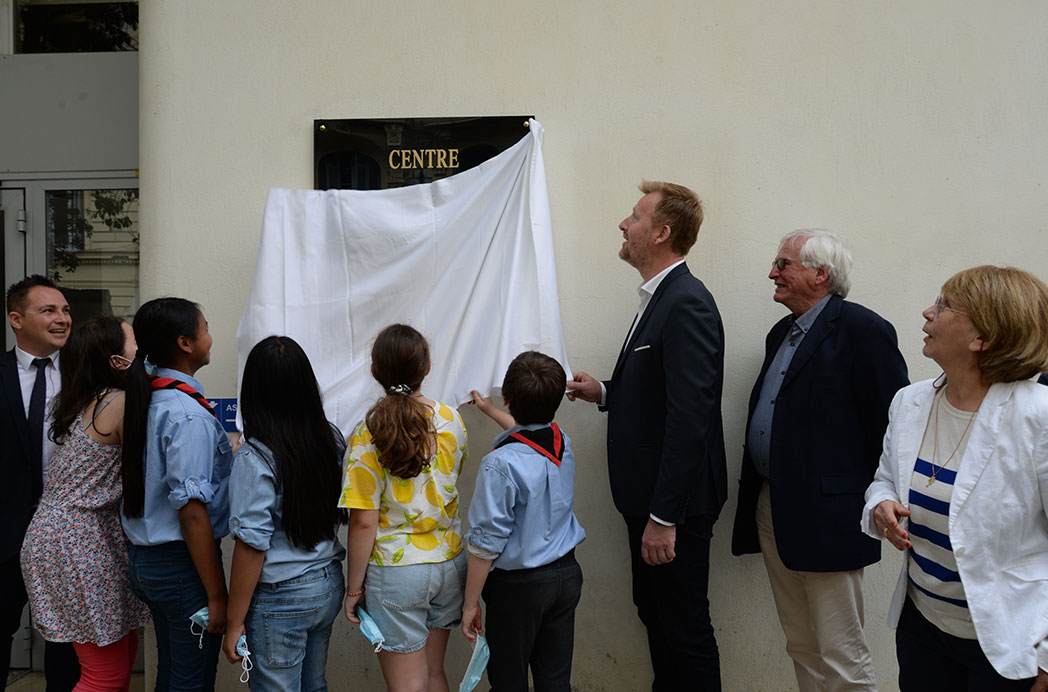 Those present then made their way to the entrance of the Protestant meeting centre, a few metres from the church, where the veil covering the plaque bearing the Gagniers’ name was waiting. Under the sunshine of that May 1, Emmanuel Gagnier, accompanied by the Cubs and Protestant Scouts and Guides of Nice, unveiled the plaque bearing his grandparents’ name, thus giving their name to the centre.
The moment that followed was full of photos and conversations. It was an opportunity for everyone to recall their ties and memories with the Gagnier family and to tell how Pierre and Hélène Gagnier had marked their lives. A sense of accomplishment filled the moment. A palpable warmth united those present.
Christine Jacob, President of the Entraide Protestante de Nice, then opened the doors of the Entraide premises so that those who wished could visit the building on which the plaque had just been unveiled. Between the clothing store and the food aid service, she presented the Entraide’s solidarity work, started by Pastor Gagnier at the time and still active today. The centre is currently helping nearly 200 Ukrainian families.
Christine Jacob pointed out that since Pastor Gagnier founded it in 1943, the Entraide has never stopped its work.