
Moussa Abadi
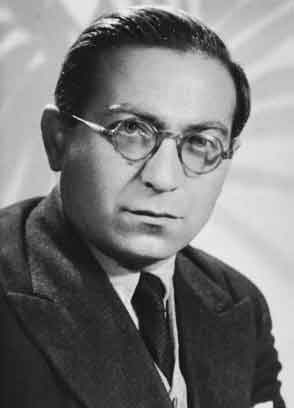
Moussa Abadi was born on September 17, 1910 in Damascus, Syria (then under French mandate), in one of the oldest ghettos in the world, to Nassim Abadi and Farida Katran. He lost his mother at the age of 12, a week before his primary school certificate exam, which he nevertheless passed. He was brought up by his maternal grandparents in a very religious environment.
He studied at the Alliance Israélite up to the equivalent of Year 10, then with the Lazarist Fathers, where he sat the bilingual baccalauréat, which allowed him to teach French in a Muslim school. At the same time, he won a scholarship to enter the École des Chartes in Paris, but the Syrian Ministry of Education refused to let him take up the place because he was Jewish. He then chose the Sorbonne and was awarded a study grant.
He arrived in Paris in December 1929 aboard the Lamartine. Although he arrived in the middle of the school year, he passed the competitive exam in six months instead of the two years of preparation usually required. He stayed in Paris for 18 months, during which, besides his studies, he discovered the art of theatre. As a scholarship holder, Moussa was contractually bound to teach in Syria for several years. He had to return to Damascus.
In February 1933, Moussa came back to France aboard the Champollion. He again had a scholarship and resumed his studies at the Sorbonne. In June 1933, he obtained a degree in Letters and a certificate in Child Psychology.
Passionate about politics, he refused to be a mere bystander. He met Bernard Lecache and joined the LICA (International League against Antisemitism).
At the Sorbonne he attended the lectures of a famous medievalist, Gustave Cohen. To illustrate the fabliaux of the Middle Ages, Gustave Cohen suggested to his students that they create the Sorbonne’s first theatre company. On May 5, 1933, Moussa performed in Rutebeuf’s “Le Miracle de Théophile” with Marcel Schneider and Jacques Chaillet, directed by Chancerel. The “Théophiliens” were born.
Moussa began a doctoral thesis, on which he worked for four and a half years, on the origins of the tale and the fabliau in the Middle Ages, supervised by Gustave Cohen.
In 1936, his scholarship was withdrawn because he was Jewish. Gustave Cohen, his “master”, found him private lessons, as he no longer had any income. Moussa worked on Ronsard and was paid by Gallimard.
In September 1939, France declared war on Germany.
In December 1939, Moussa met Odette Rosenstock, a young doctor, at the home of a mutual friend, Olga. It was also at this time that Moussa published an article against fascism under the name Marcel Samade.
On June 8, 1940, Moussa cycled to Montargis to see Odette, who was working there as a medical inspector. He continued his journey and reached Vichy on July 14, 1940; he met the representative of the Levant States at the Ministry of Foreign Affairs, who suggested that he return to Syria. He refused and travelled on to Marseille, then Nice, in the free zone. In Nice he met Gustave Cohen again and staged several of the lectures Cohen gave on medieval fabliaux. It was during one of these performances that Gustave Cohen introduced Moussa to Monsignor Rémond.
In November 1942, Odette joined Moussa in Nice. They both went to a community centre on boulevard Dubouchage, where a Jewish committee was trying to help the many Jewish refugees.
Two events led to the creation of the Marcel network by Odette and Moussa:
April 1942, in Nice, on the Promenade des Anglais: a Jewish woman was beaten by jackbooted militiamen. A small child was crying in the middle of the group of onlookers. Moussa could not bear the sight.
November 1942: the Italians invaded the Alpes-Maritimes. Faced with the German advance, many Austrian, German, Belgian, Dutch and French Jews fled and took refuge in Nice. The region was under Italian control, and the Italians did not apply Vichy’s anti-Jewish laws.
In the first quarter of 1943, a Jesuit friend of Moussa’s suggested that he meet Father Penitenti, chaplain to the Italian troops on the Eastern Front, who was passing through Nice. Don Giulio Penitenti described to Moussa the pogroms and the Nazi persecutions in Eastern Europe. Moussa refused to believe him; Don Penitenti took out his crucifix, laid it on his hand and swore before Christ that what he was saying was true. Moussa ran to Odette, and together they decided to resist by saving the most vulnerable: the children.
This was the birth of the Marcel network, which saved 527 children.
In August 1944, the Côte d’Azur was liberated. Moussa moved into the premises of the Commissariat for Jewish Affairs. The surviving parents came to collect their children. Those who were left alone were entrusted to the O.S.E. (Œuvre de Secours aux Enfants), an organisation that had homes able to take them in. Moussa set up a social service, which he later turned into a health clinic, moved to 31 avenue de la Victoire.
Odette, back from deportation in June 1945, joined Moussa in Nice and then worked as the clinic’s doctor. They left it at the beginning of 1948.
On November 3, 1959, Moussa married Odette at the town hall of the 12th arrondissement of Paris.
Moussa died on Monday, September 15, 1997 at the age of 87. He is buried in Montparnasse cemetery.
Moussa and the theatre
In 1933, Moussa Abadi attended the lectures of a famous medievalist at the Sorbonne, Gustave Cohen. To illustrate the fabliaux of the Middle Ages, Gustave Cohen suggested to his students that they create the Sorbonne’s first theatre company. On May 5, 1933, Moussa performed in Rutebeuf’s “Le Miracle de Théophile” with Marcel Schneider and Jacques Chaillet, directed by Chancerel. The “Théophiliens” were born.
In 1937, with the Théophiliens, he performed “Le Vrai Mystère de la Passion” in front of Notre-Dame de Paris before President Albert Lebrun.
That same year, Moussa met Copeau, Barsacq, Dasté and Svetlana Pitoëff and was hired as an actor in Barsacq’s company at the “Quatre Saisons” theatre. The company performed Carlo Gozzi’s “The King Stag” at the Théâtre des Champs-Élysées, as well as at the Paris International Exhibition. From October 1937 to February 1938, the Compagnie des Quatre Saisons was engaged by the French Theater of New York thanks to Miss Robinson, a wealthy American patron. Together with the French Foreign Ministry, she organised a five-month tour with eight plays, including The King Stag and Knock. Jouvet coached Moussa for the role of Knock.
On June 13, 1938, Moussa returned to Paris and in the autumn he left the Quatre Saisons. The adventure of the theatre cooperative came to an end.
After the war, he returned to his passion for the theatre and presented a programme on Radio France Internationale called “Images et visages du théâtre d’aujourd’hui” (Images and faces of today’s theatre). From 1959 to 1980, he recorded more than a thousand radio interviews with playwrights, actors, directors and young talents still unknown to the public (some of whom would become famous), always serving the person he was talking to, culture, the theatre and the French language. From 1977 to 1981, he chaired the committee for support to new drama, and he was also a member of the committee supporting young theatre companies.
List of records | List of personalities
His love of literature led him to writing. He published “La Comédie du théâtre” with Julliard in 1985, and in 1993 “La Reine et le Calligraphe” with Christian de Bartillat. “La Reine et le Calligraphe” received the Grand Prix de la Nouvelle (short story prize) of the Académie Française and was translated into Hebrew. In 1999, “Shimon le Parjure” (published posthumously) came out with Éditions Du Laquet.
Comédie du théâtre (extracts) | Théâtre en foire (extracts)
Bibliography
La Reine et le Calligraphe (The Queen and the Calligrapher)
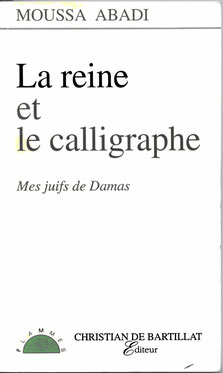 Publisher: Bartillat
“Here are the great joys and sorrows of an Eastern Jewish community of which only illusion and memory remain today. This book recalls scenes – comical, tender, humorous and often dramatic – that Moussa Abadi himself lived through in Syria before leaving, at the age of 19, the ghetto of sadness and tales. With exceptional brilliance and superb language, he brings back to life the images and faces of the ‘creatures of God’ such as the calligrapher, Rosa the maid, the barber and the cobbler: colourful characters who marked his childhood and who make us smile, laugh and cry. By handing down these age-old traditions, the author, born in Damascus and for twenty years a drama critic at Radio France, gives us the illusion that time will never swallow them up.”
> Buy: www.amazon.fr
Shimon le Parjure (Shimon the Perjurer)
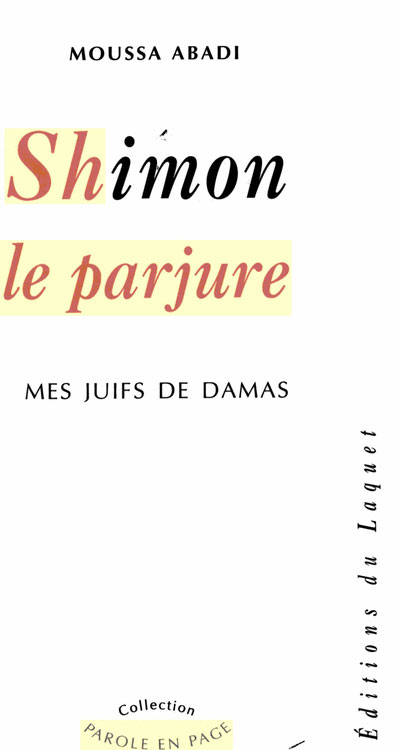 Publisher: Du Laquet
After “La Reine et le Calligraphe”, Moussa Abadi resumes his stories, full of human warmth, sensitivity and that gentle, very personal humour which made us discover and love the world of the Damascus ghetto.
The stories gathered in this collection are true stories passed through the filter of memory. But it is also and above all a book of wisdom, kindness and gentle irony, written in language of superb simplicity and clarity. A book of tenderness and love.
> Buy: www.fnac.com | www.amazon.fr
La Comédie du théâtre (The Comedy of the Theatre)
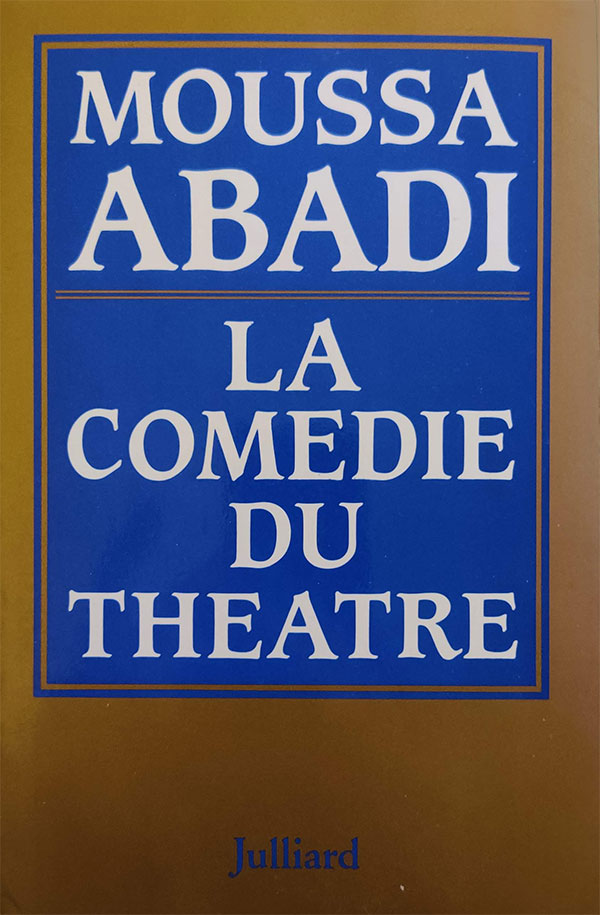 Publisher: Julliard
After a thousand radio interviews with the most prestigious or most representative playwrights, actors, directors and theatre managers of our time, Moussa Abadi tells us about this “ample comedy” as he saw and lived it during his twenty-five years of almost daily theatre-going.
No doubt his book, which is part reportage, part satire and part pamphlet, will set a few teeth on edge… But make no mistake: this outspoken book is also and above all a book of love. It is the cry of revolt of a watchful witness who says out loud what people whisper everywhere, and who appeals to the “supreme judge”: the audience.
In the press
CHILDREN IN DANGER… GHOSTS IN PERIL… An interview with Moussa Abadi (Les Anciens de l’Alliance)
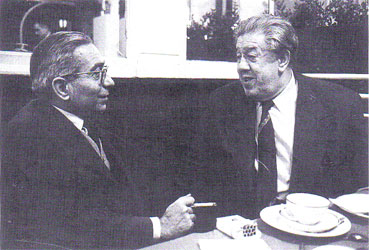 “The Alliance Israélite Universelle? I owe it everything. Without it, I would not be here and I would not have had the career I have had.” The man speaking is Moussa Abadi, a legendary figure of the Jewish Resistance and a man of the theatre: a successful actor before the war, drama critic at Radio France Internationale from 1959 to 1981, then chairman of the committee for support to new drama, member of the committee supporting theatre companies, author of countless pages on the theatre and of a moving book of memories, La Reine et le Calligraphe – Mes juifs de Damas, recently published by Christian de Bartillat and awarded the short story prize of the Académie Française. …
In memory of Moussa (Les cahiers de la maison Jean Vilar, 1st quarter of 1998).
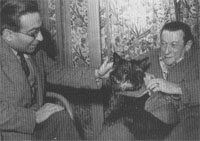 More than a member of the Board of the Association Jean Vilar, it was above all a friend who passed away on September 15 last.
A friend whose life merges with the history of the theatre of this half-century that we love to recall. It would take far more than this short piece to do it justice. …
Honours
Officer of the Order of Arts and Letters
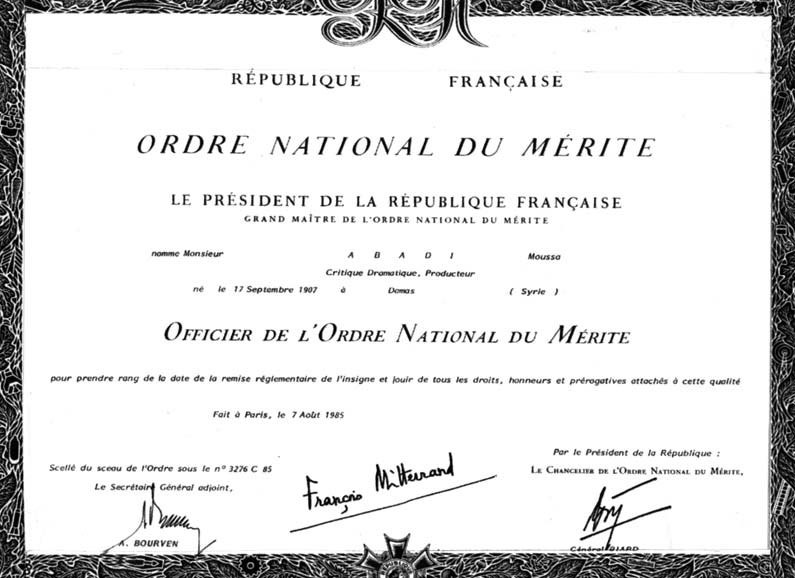
Beaumarchais Medal
Medal of the Société des Auteurs et Compositeurs Dramatiques
Resistance Medal
Medal of French Gratitude (Médaille de la Reconnaissance française)
Legion of Honour
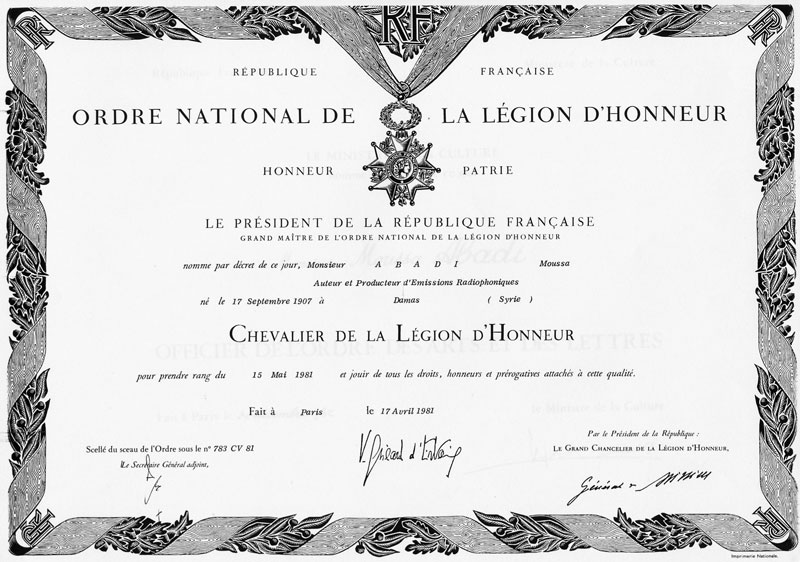
“Jewish Rescuer” citation in April 2020 (see the ceremony)