
Theatre and Resistance: Depersonalisation & Identity
June 22, 2009
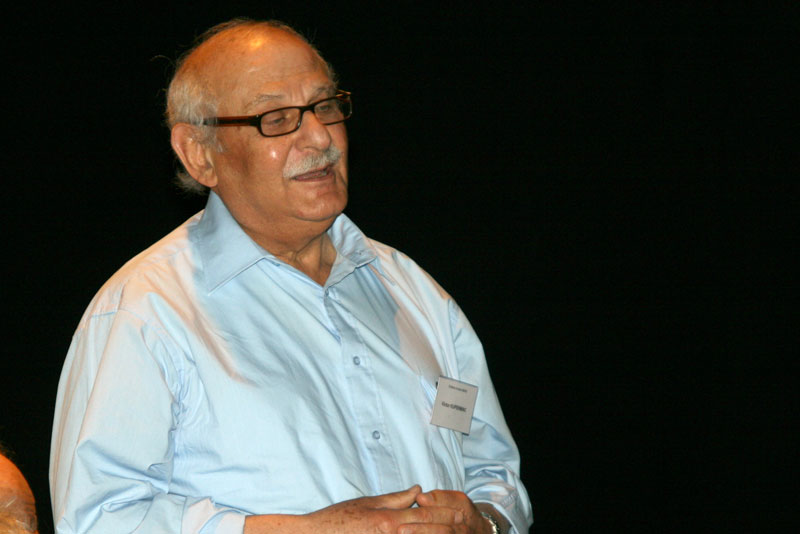
“The Marcel network, or the Comedy of the Theatre”, according to Victor Kuperminc
Drama in 2 acts by MOUSSA & ODETTE ABADI
First performed on June 22, 2009 at the THÉÂTRE OUVERT, Paris
The scene is set in the Cité Véron, near the Moulin Rouge in Paris, at the foot of the Butte Montmartre.
There the benevolent ghosts of Boris Vian and Jacques Prévert still roam.
Characters
 LUCIEN ATTOUN: The host
 PIERRE-EMMANUEL DAUZAT: The ringmaster
 CATHERINE JOURDAN: The friend from Nice
 ANDRÉE POCH-KARSENTI: President of “Les Enfants & Amis Abadi”
 HELEN SOLTERER: The American friend
 MARIA LANDAU: The good doctor
 CHARIF KIWAN: The friend from Damascus
 JEAN-CLAUDE GRUMBERG: Theatre friend
 VICTOR HAÏM: Theatre friend
 ROBERT POUDEROU: Theatre friend
A few of the children saved, among the five hundred and twenty-seven…
And ARIANE MNOUCHKINE and PATRICE CHÉREAU present in sound and image…
ACT 1
Lucien Attoun: “Good morning, ladies and gentlemen, thank you for coming in such numbers to recall the memory of Moussa and Odette. Our theatre is wide open to you. I hand over to Pierre-Emmanuel Dauzat, our moderator – author and translator of many works written in a multitude of languages, including… Yiddish.
Pierre-Emmanuel Dauzat: And here is Catherine Jourdan, philosophy teacher and lifelong friend of Odette and Moussa, who describes daily life in Nice in 1939–45; photos from the period punctuate her account, and Vincent Daufin, actor, brings to life the great and small events of Nice.
Then Andrée Poch-Karsenti, president of “Les Enfants et Amis Abadi”, author of “Les 527 enfants d’Odette et Moussa”, initiator and soul of this day, follows in the footsteps of Moussa, a man of culture turned resister – from the road to Damascus to the Promenade des Anglais. And Vincent Daufin brings back to life Rutebeuf’s “La Complainte”, so dear to Moussa’s heart.
And see on the screen Ariane Mnouchkine telling Lucien Attoun how she met Moussa, and how much her hectic life was changed by it.
Let the friends of the theatre now come to the platform and share with us the ups and downs of their relationships with Moussa, sometimes stormy, always friendly. Come up here, Roland Monod, Robert Pouderou, Jean-Claude Grumberg. And you, Victor Haïm, tell us with your usual verve how Moussa congratulated you on one of your plays in which you had kept a part for yourself, and added: “a pity that you are so bad!” And you, Lucien Attoun, our host, read us a vigorous and comical page from Moussa’s remarkable book “La Comédie du Théâtre”.
INTERVAL and REFRESHMENTS
ACT 2
Pierre-Emmanuel Dauzat: Let Helen Solterer, our American friend, professor of French literature at Duke University (North Carolina, USA), now come and explain to us why and how the practice of theatre prepared the depersonalisation of the Jewish children saved by the Marcel network. And let Natacha Karsenti come and recite a poem by Charlotte Delbo, another great resister.
And now our dear friend Dr Maria Landau, neuropsychiatrist and psychoanalyst, comments on the images from her film “Le Réseau Marcel”, images that bring back to life for a moment Odette and Moussa describing the depersonalisation of “their” children.
A few of these children come to bear witness to their own past experience, how they lived through that episode in which their “identity was stolen”.
And here is a last-minute guest: Georges Loinger, great resister, who recalls his own experience within the OSE and who was behind the rescue of hundreds of Jewish children, mainly at the Franco-Swiss border. This tall young man will celebrate his hundredth birthday next year, and Lucien Attoun here will open the doors of his Théâtre Ouvert to him for this extraordinary anniversary.
And now our friend from Damascus, Charif Kiwan, columnist and editor at “Al Balad”, a Lebanese Arabic-language daily, and also at La Documentation française. Kiwan, being “Syrian”, has undertaken the translation of Moussa’s masterpiece, “La Reine et le calligraphe”. He asks himself this strange question: did Moussa Abadi exist? And of course he gives you the answer.
I now call on Victor Haïm to give a talented reading of “La malédiction”, a story from “La Reine et le Calligraphe”.
And let our friend Maria Landau come back to the platform to analyse one of the finest books written about deportation, “Terre de détresse” by Odette Abadi – an unforgettable and unique experience. And let Natacha Karsenti share her emotion and read us an extract.
Finally, I hand the microphone to our host Lucien Attoun, whom we thank for his warm and friendly welcome.
Lucien Attoun: a surprise and a gift – here is a telephone interview with Patrice Chéreau, who in turn recalls meeting Moussa.
Voice of Moussa Abadi, Senate conference, May 21, 1995
CURTAIN