
Odette and Moussa ABADI in LIBERTÉ DU JUDAÏSME
September 1st, 2015
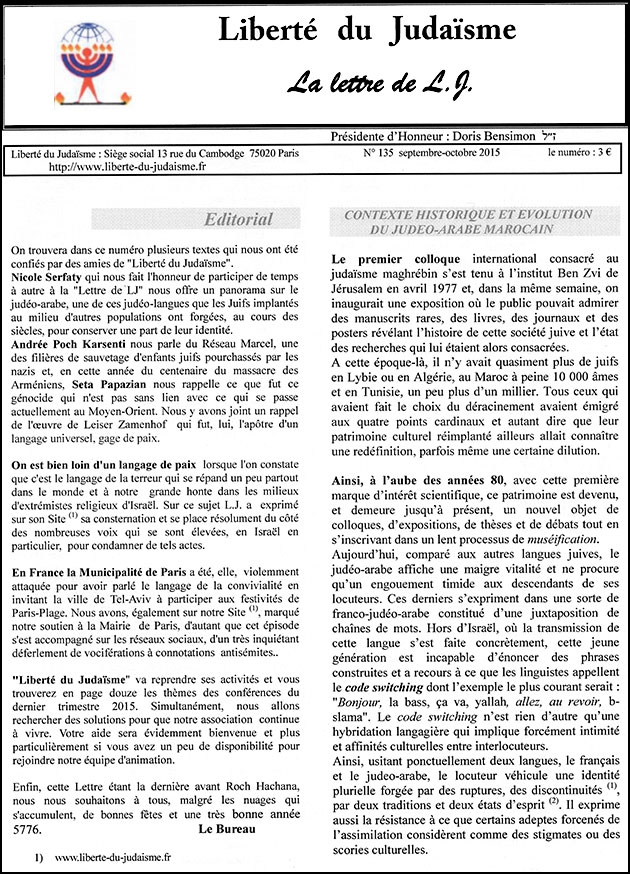
The Marcel network
Telling the story of the Marcel network would almost be like beginning an oriental tale, were it not for the tragic events that led to its birth: on September 17, 1910, Moussa Abadi was born in Damascus into a religious Jewish family. He studied at the Alliance Israélite and then entered the Lazarist college.
After a competitive exam, he won a scholarship from the Syrian government. He wanted to enter the Sorbonne and obtain the qualification of “Teacher of French Abroad”. He went to Paris, where he stayed for eighteen months before his contract obliged him to return to Damascus. He came back in 1933. In Paris he discovered the theatre and Louis Jouvet, the Middle Ages with his master Gustave Cohen, and also politics through the meetings at the Mutualité…
In December 1939, he met Odette Rosenstock. She was born on August 24, 1914 in Paris, into a family from the Bas-Rhin on her father’s side and the Mayenne on her mother’s. She was completing her medical studies. “Wholehearted, passionate, outraged by injustice, uncompromising” was how she described herself… In early 1939 she went to the Spanish border to help refugees fleeing Franco’s regime… A secular Jew, increasingly concerned by her Jewishness, she was alarmed by the antisemitic writings of newspapers such as “Je suis partout” and “Gringoire”. She was appointed Social Security Medical Inspector at the evacuation centres for Paris schoolchildren, then Medical Inspector of schools in the Loiret, in Montargis. When the Vichy government promulgated the first Statute on Jews, which excluded all Jews from the civil service, Odette lost her professional status. She returned to Paris to treat foreign nationals in clinics, which soon closed their doors.
Meanwhile Moussa, driven out of the University, had set off for Nice, where he met his teacher Gustave Cohen again. In May 1941, Gustave Cohen gave a lecture on medieval poetry, and Moussa Abadi accompanied him to recite verses by François Villon… In the audience was the Bishop of Nice, Mgr Paul Rémond.
Deprived of the means to practise, Odette joined Moussa in Nice in November 1942. She had no resources and agreed to work nights looking after children in a clinic.
At the beginning of 1943, Moussa Abadi met a chaplain to the Italian troops who had come back for a while from the Russian front, Father Penitenti. He told of the camps and the massacres suffered by Jews in the East. He used all his powers of persuasion and all his faith to warn Moussa and overcome his scepticism, predicting the darkest future when the Germans arrived. When the priest returned to the front, Moussa told Odette, and together they decided, as Moussa would put it, “not to stand by and watch the procession go past”.
At the same time, the O.S.E. (Œuvre de Secours aux Enfants), which had withdrawn to the southern zone, went underground, and Georges Garel was given the task of setting up a network to rescue children. To keep them as safe as possible, he considered it essential to disperse the children in non-Jewish settings where they would not be known as Jews, and to “Aryanise” their names. In August 1943, Georges Garel and Moussa met to lay the foundations of a new network. Moussa sought and obtained a meeting with Mgr Paul Rémond, Bishop of Nice. During this meeting, Moussa asked Mgr Rémond to “live his faith” by helping him save Jewish children from deportation. The bishop agreed to help Odette and Moussa and offered them hospitality at the bishop’s residence: an office on the ground floor opening onto the garden (handy for escaping) and the help of his closest colleagues. He gave them the list of the schools, boarding schools and convents of the diocese, appointed Moussa “Inspector of Catholic Private Education for the diocese of Nice” and Odette “Social worker in charge of the evacuation of the children of Nice in the event of bombing”. Moussa became Monsieur Marcel. He created a false identity for himself, taking the Arabic pseudonym Fouad el Mousri, which means “the Egyptian”. Odette Rosenstock became Sylvie Delattre. The Marcel network had been formed.
At the end of 1943, Odette met mayors and contacted secular institutions and Pastors Evrard and Gagnier, who gave her lists of families likely to take in children. They had to act with caution, as denunciations were always possible.
Moussa wrote: “Difficult, dangerous, uncertain visits. We had to approach trustworthy people, ask careful questions and never reveal ourselves until we had sufficient guarantees. The parish priests and mayors, the schoolteachers and the local notables of some villages saw us file past them, asking a few questions about the possibility of finding lodgings in their village. We noted down our information with the secret hope that it would never be needed. It was August 1943; the south of France was still under Italian occupation. Of course, the collapse of our ‘Latin sister’ was expected soon, but we still wanted to hope that this favoured part of the country would know neither the Gestapo, nor torture, nor mass deportations.”
So, little by little, the places that could take in children took shape; the office at the bishop’s residence became a veritable workshop for false papers, where Mgr Rémond did not hesitate to lend Moussa a hand! On September 3, 1943, Italy signed the armistice. On September 10, 1943, the notorious Alois Brunner and the Gestapo entered Nice to pursue their macabre hunt for Jews. They searched hotels, houses and hospitals. Monsieur Marcel and Sylvie Delattre were ready… A collection centre was set up temporarily in the OSE premises: 140 children were taken in there in the first ten days.
Moussa recalls: “The Gestapo cars were criss-crossing the streets of Nice, their informers were already at work, and the slightest carelessness would have led to the arrest of dozens of children whom we had sworn to save. Each day of that grim month of September brought us more abandoned children, taken in by neighbours, the corner grocer, dairywomen, concierges. We had to take them in a great hurry and place them as best we could, but also reassure them and console them for the hasty departure of their parents – their eyes red, their faces drawn, suddenly deprived of their childhood.”
The workload was enormous and panic was at its height. Several establishments opened and closed their doors behind the children: the Institut Sainte-Marthe, the Jeanne-d’Arc boarding school and the Maison des Enfants, the preventorium in Grasse, the Institut Maison Blanche, the Poor Clares’ boarding school, the Institut Don Bosco and the Collège Sasserno in Nice – and families too… In the convent of the Poor Clares there was a little house. Moussa used it to “recreate” identities for the children: to convince the older ones that their name was no longer the one that placed them in a family history, that they were born on that day of learning, wearing like new clothes a first name and surname they had never known before. Being brutally separated from their parents was not enough; being plunged into the anguish of clandestine life, facing this man who tirelessly repeated, “You are no longer called by the name that was yours; here is the one you must answer to from now on,” was still not the end of the effort required. They had to learn the lesson and, with the instinctive knowledge of childhood, sense the danger. But they also had to lock their secret inside themselves, go underground, join the resistance, become a “Hidden Child”. No sharing with a “best friend”, no confiding on days when their hearts were too heavy. Sometimes words slipped out, an untimely confidence was made: then another hiding place had to be found urgently – another break, new anxieties, other traces… By November 1943, one hundred and eighty children had been “brought to safety”. Once they were hidden, they also had to be provided for, with ration cards.
Moussa recalls: “I got in touch with some senior officials of the supply and rationing service of the city of Nice. With the agreement of the prefecture and the diocese, the supply service promised to help me make these false ration cards. I had to do a real training course with some of the rationing officials to learn how to make a ration card: number, address, stamp, date of issue – everything had to be done ‘legally’. After a few days of difficulties and trial and error, I set up a false ration card service intended solely for children under fifteen. Each of them was given a new card within twenty-four hours of being placed.”
The blank cards were supplied by Monsieur Broch, then deputy director of the rationing service of the city of Nice. Moussa, an expert forger! Further valuable help came from the Prefect of the Alpes-Maritimes, Monsieur Escande, who gave him a safe-conduct pass stating that he was a Muslim, so that he was not subject to the regulations concerning Jews.
Besides hiding and feeding the children, they also had to be clothed; their board had to be paid, medical care provided when necessary, small purchases made. Help came from the American Quakers in the form of food, and financially from the Joint Distribution Committee, represented by Maurice Brenner, whom Moussa met on his trips to Paris. Hiding, feeding, clothing, keeping the children alive during this period – but also thinking of “afterwards”, of hope.
For safety reasons, parents did not know where their child was hidden; so that the children could be returned to their families at the end of the hostilities, index cards were drawn up with their photo, date and place of birth, the names of their parents and brothers and sisters, and of the people who had entrusted the child to the network. The cards were made in three copies: one set hidden in the garden of the bishop’s residence, another mixed in with the papers in the office, and the third sent as soon as possible to the Red Cross in Switzerland. About a hundred of these cards have been found.
Odette travelled across the département, visiting the hiding places; she wanted to make sure the children were well, and she brought them her gentleness, her attention, a semblance of normal life. The few children whose memories of the events remain vivid remember how they waited for “Mademoiselle” to come, and the care, attention and time she gave them. Contrary to what she let them believe, Odette would leave Jeanne d’Arc in Grasse to visit other children in Magagnosc, Cannes, Gréolières, Thorenc and Nice, giving each of them what they were waiting for, using public transport, braving bad weather, the Gestapo and the Milice – until the morning of April 25, 1944, when the Milice burst brutally into 6 rue Gounod in Nice. She had time to destroy the few compromising papers she had before she was taken away.
She was taken for her first interrogation to the Hôtel Excelsior. Odette mentions “a few slaps, some pushing around” and does not want to dwell on “uninteresting details”. She was then taken to the Hôtel Hermitage, where the interrogations were by turns brutal and almost friendly, promising freedom in exchange for information. Odette did not give in. She knew she was in prison and that, once arrested, there is “as it were a great line drawn, and the feeling that your life is over, that something else is beginning. You put yourself in the shoes of someone who has been arrested, who must defend themselves and above all defend those who remain on the other side of the wall” (1).
She was transferred to Drancy on May 2, relieved no longer to face interrogations with the risk of betraying “Monsieur Marcel”; seventeen days later, in a wagon with sixty people, fifteen of them children, she was sent to Auschwitz. She was in charge of the Revier (the camp infirmary), caring for the sick to the point of exhaustion, with minimal means, with the energy that never left her and the compassion she always showed. In November 1944 the Nazis emptied Auschwitz, and Odette was sent to Bergen-Belsen.
Back from hell, Odette bore witness more than forty years later, based on notes made in 1945, in an admirable book: “Terre de Détresse” (2). On the day of Odette’s arrest, Moussa was returning from Paris and owed his safety only to the building’s concierge, who gave him a nod, signalling him to keep walking. After Odette’s arrest, the situation became difficult for Moussa, who found himself alone facing the scale of the task and, above all, increasingly in danger of being arrested himself. He left the bishop’s residence and kept moving as much as possible: he knew all the times of Mass and slept on the premises of the Cours Sainte-Geneviève, which he had to leave early in the morning. Another year went by in which Moussa, with no news of Odette, carried on, helped by a social worker appointed by the O.S.E., Nicole Salon, who would be arrested and deported.
On August 28, 1944, Nice was liberated. Thumbing his nose at History, Moussa set up at 15 avenue de la Victoire in the premises of the Commissariat for Jewish Affairs: there he received surviving family members to return the hidden children to them. Of all the little ones who passed through the Marcel network, two children were deported because of an indiscretion. Many others were now orphans, having lost one or even both parents. Moussa worked to ensure that each of them was looked after: family reunification, searching for parents, returning children to their homes, regularising their civil status and continuing their care.
It was in this atmosphere of relentless work that Odette arrived, back from the death camps. In one of Moussa’s “logbooks” one can read, with great emotion, under the date Wednesday, June 6, 1945: “Our friend Dr Odette Rosenstock came to the clinic for an injection. She was visibly moved to find on our board the names of the children she had hidden during the clandestine period and to whom she had devoted herself until her arrest. When will she take her place among us again? Not for two or three months. She needs rest and calm.” Above all she needed to find herself again, to pull herself together, to readjust. She would try to live. Yet she went back to work sooner than Moussa expected: on June 29 she was already accompanying five children to Paris as part of family reunification.
The Marcel network is an example of solidarity and mutual aid, found in other instances of Resistance too. It highlights the will, the awareness and the courage of Jews in organising their own rescue. That rescue would not have been possible without the help of many anonymous outstretched hands… What could be more unlikely than the cooperation of a Syrian Jew and a Pétainist prelate, of members of civil society and of the underground? And yet, even though there were denunciations (two children were victims of them because of careless talk by the priest who was hiding them), how many men and women stood up to say NO to barbarity? By the end of the war, 76,000 Jews from France had been deported, including more than 11,000 children. Odette and Moussa helped to save the lives of 527 children… I owe them mine.
Andrée Poch-Karsenti
President of the Association des Enfants Abadi
1) Andrée Poch-Karsenti: awaiting return from Paris
2) Odette Abadi, “Terre de Détresse”, likewise
La Lettre de L.J., June–July
Editorial and administrative office
13 rue du Cambodge 75020 Paris
Publication director
Isidore Jacubowiez
Editorial committee
Simone Bismuth, Flora Novodorsqui
Michel Mohn, Danièle Weill-Wolf
Copytoo, 281 rue des Pyrénées 75020 Paris
Legal deposit on publication ISSN 1145-0584
Signed articles are the sole responsibility of their authors
To be kept informed of our activities in real time and to take part in exchanges and discussions with other readers of La Lettre de L.J., join the Yahoo group Courrier-L.J. If you are interested, please send an email to: courrier@liberte-du-judaisme.fr