
Talk at the Romainville primary school
February 3, 2023
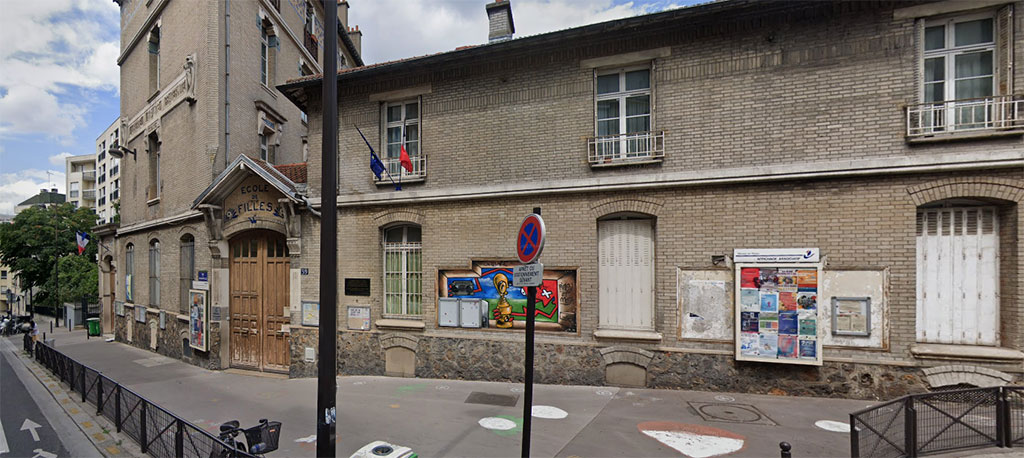
January 13, 2023: we are a little far from the usual commemorative events, the ones described as the “duty of Memory” – yet it was in that context that, for the third year, Armelle Gonzalez, head of the primary school in the rue de Romainville, invited me to meet the final-year primary class of their teacher, Vanessa Lucas.
Not in the spirit of “Duty”, but rather of passing on, the teacher having adopted the quotation from Simone Veil on the file prepared for the pupils: “the only duty is to teach and to pass on”. The file sets out the week’s programme. The children leave school to visit various places, and their first visit is to the Memorial of the Martyrs of the Deportation in Paris, in memory of all those deported from France, where they are offered a workshop entitled “Building Memories”. On the second day comes a visit to the Mémorial de la Shoah where, during the activity “The child with two names”, the young visitors discover the different stages of the exclusion of the Jews of France under the Occupation. This period is reconstructed with the help of Yiddish songs, archive documents and family photographs.
So much for the outings; a third session was devoted to my testimony in the classroom. The children had read a short account of my story and of the work of the Marcel network, and had prepared questions. They were especially attentive, interested, touched and empathetic.
For each activity, the questionnaire has a page next to the visit where the pupil can express “what I did… what I understood… what I learnt… the questions I am asking myself after this visit”
Some of their questions:
Were you scared?
Did the Nazis come to your house?
How old were you when it happened?
Where were you hidden?
What were living conditions like while you were in hiding?
What did you do while you were in hiding?
Did you still have a normal child’s life, with games and laughter? What do you think of that childhood?
Were you well looked after?
At the end of the war, did you join your brothers in Switzerland, or did they come back?
How did you find out your parents had died?
Do you miss them?
How did you cope with your parents’ deportation?
Did you see Jacques Rous again after the war?
Did you stay friends with the Rous family after the war?
What became of Odette, Moussa and Monseigneur Rémond?
etc…
Then a few of their comments:
“We learnt a lot of things with Andrée: on Friday, January 13, a witness, Andrée Karsenti, came to our class to tell us the story she lived through with the Marcel network, made up of Odette and Moussa, who saved her… I was able to ask the questions I had prepared; I was sad for Andrée… it must have been very hard, especially with her parents being deported! In my head I thanked Moussa Abadi and Odette Rosenstock for their love of children! I understood that the names of the people who organised the rescue of the hidden children were Odette Rosenstock and Moussa Abadi, and that you could change your name to protect yourself….”
“I learnt that you have to pass things on to other people, because if you don’t, the people who lived through the war will die and no one will be able to tell the story! And that you shouldn’t be interested in a person’s religion, but in the help they give.”
I ended my account with Moussa’s voice at the Senate, which made a great impression on them.
The explanatory colour documents on the Second World War come with a glossary of the words used, the key dates and a map of Europe at the time: remarkable.
The week ended in the playground, in front of the plaque bearing the names of the deported children of this school, with the “Chant des Partisans”, songs of the Resistance and poems, notably by Martin Niemöller, Marianne Cohn, Robert Desnos and Louis Aragon, as well as Missak Manouchian’s last letter. And to continue the chain of Memory and passing on, the ceremony took place in the presence of the invited Year 5 pupils, who will follow the same programme next year – the baton passed on.
I can only warmly thank Mrs Lucas and Mrs Gonzalez, and the children, for these so moving moments of sharing, full of hope.
Andrée Poch-Karsenti