
Comic book: “Justes parmi les Nations” (Righteous Among the Nations)
April 24, 2023
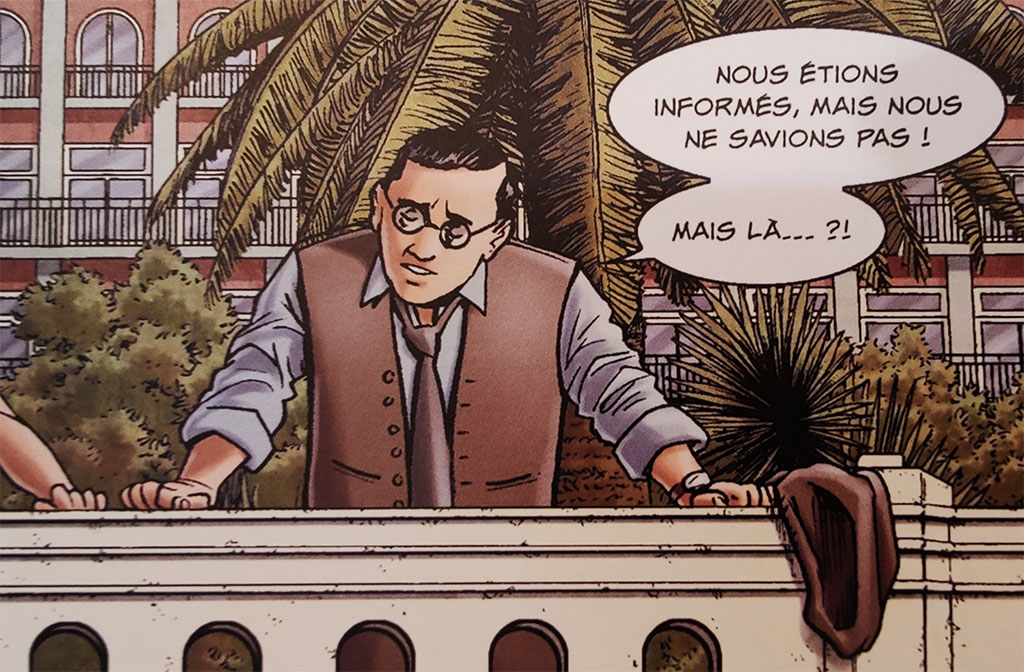
This April 2023, the comic book “Les Justes” was published by Éditions Plein Vent. While it was being prepared, the authors asked us for our comments on the first pages.
The authors deal with how two networks saved hundreds of Jewish children in the Alpes-Maritimes during the Second World War. The two networks in question are, on the one hand, the Marcel network created by Odette Rosenstock and Moussa Abadi and, on the other, the network created by Pierre Merli. The authors have a fictional narrator tell how he was saved by these networks. With good-quality artwork, the comic aims to make the history of these networks known to a new and wider public.
While the publication of a comic book is to be welcomed, readers should bear a few things in mind. The distinction between the two networks is not clearly made. In the story, the shift from one network to the other is not signalled. Some press articles have in fact confused the two, attributing the creation of the Marcel network to Odette, Moussa and Pierre Merli. That is of course not the case. Pierre Merli played no role in the Marcel network.
The comic mixes real facts, suppositions and sometimes narrative or visual licence. For example, the cover shows Jewish children wearing the yellow star, although it was never one of the measures in force on the Côte d’Azur. A few errors have crept into the story, sometimes without the authors’ knowledge – for example the name of Monseigneur Rémond’s secretary, whom they call Mademoiselle Lagarde instead of Mademoiselle Lagache, probably because they referred to the Wikipedia page on the Marcel network, which contained this error at the time of their research (since corrected).
We regret that some aspects were not developed further, such as depersonalisation, an extremely important element in the history of the Marcel network, which is given only one page without further explanation. Other parts of the story are also passed over in silence, notably regarding Odette, who is presented as a mere wife (author’s note: they were not married at the time), omitting her work as a doctor and her deportation.
The authors have clearly chosen to highlight the role of the Catholic Church at the expense of other forms of Resistance. The Protestant pastors, the secular institutions and the families are only mentioned, unfairly playing down their role and conferring the title of “Righteous” mainly on members of the clergy.
Finally, at the end of the book the authors took care to thank the institutions that helped them, including our association (whose name they mangled in passing, calling us “Enfants d’Abadi”).
This is the first time the Marcel network has been the subject of a comic book. Let us hope this initiative will inspire other authors (books, cinema…).