
The Lycée d’Arsonval in Saint-Maur
January 29, 2024
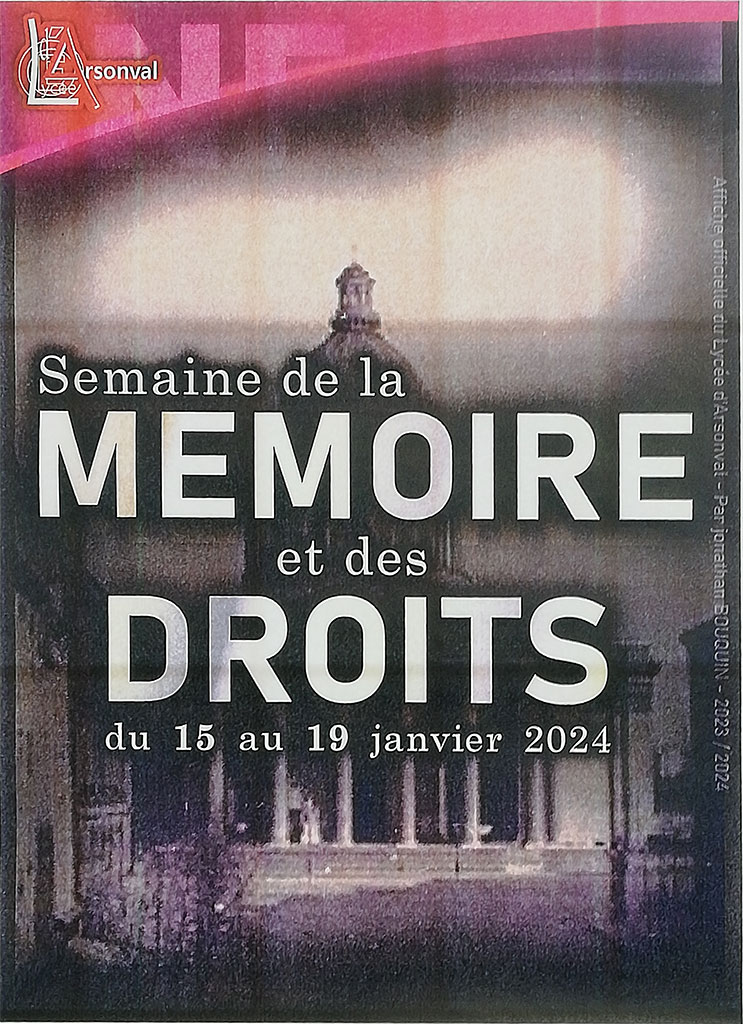
It was October 10, 2023, two days after that dark October 7 that was in everyone’s mind. Invited by Mrs Corneloup, history teacher at the Lycée d’Arsonval in Saint-Maur, I found myself facing about seventy-five final-year pupils who had already watched the DVD “Le Réseau Marcel”, to explain, present and talk about these heroes who wrote part of the History of their time.
The young people were attentive, interested and questioning, but also careful not to be too intrusive about my own story. To answer a young man’s question, which has stayed with me ever since – “Madam, what values do you want to pass on to us?” – I played the last three minutes of Moussa’s message at the Senate on the 1995 day devoted to “The Destruction of the European Jews” (you can listen to it on our website), and when I asked him whether I had answered his question, very solemnly he murmured: “Yes, Madam.”
The work these pupils were asked to do is based on the Week of Memory, with this question: “Why a week for the rights of Memory?”
Some of these pupils were due to go to Auschwitz; two other groups were formed to create panels about the Marcel network and the hidden children.
On Thursday, January 18, 2024, an exhibition of their work and a performance of their musical and poetic talents brought parents and pupils together in the school’s main hall.
The school choir sang Jean-Jacques Goldman’s song “Comme toi” as a round, with great emotion; readings of texts by Charlotte Delbo and Y. Katzenelson, a four-handed reading of the logbook kept by two girls during their visit to Auschwitz, and a piece by two pupils describing the ceremony commemorating November 11, 1918 preceded a girl’s violin performance of the music from the film “Schindler’s List”.
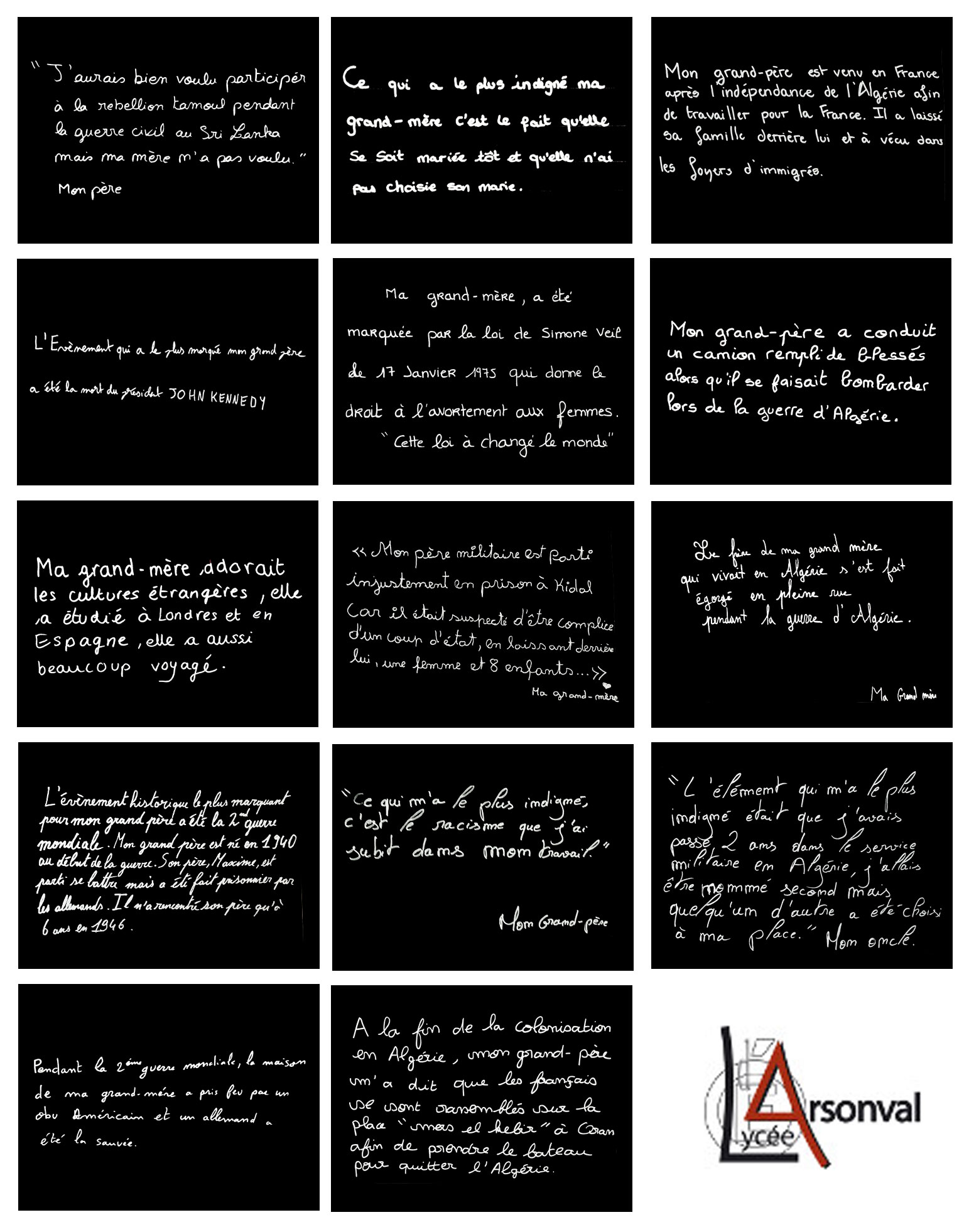
The Memories were mingled, and so powerful: family memory as well as the memory of Algeria (illustrated by white sentences on a black background), the celebration of the 40th anniversary of the “March for Equality and against Racism”, which set out from Marseille for Paris in November–December 1983, and also the Resistance, with the account of Simone Veil’s deportation.
Pupils’ work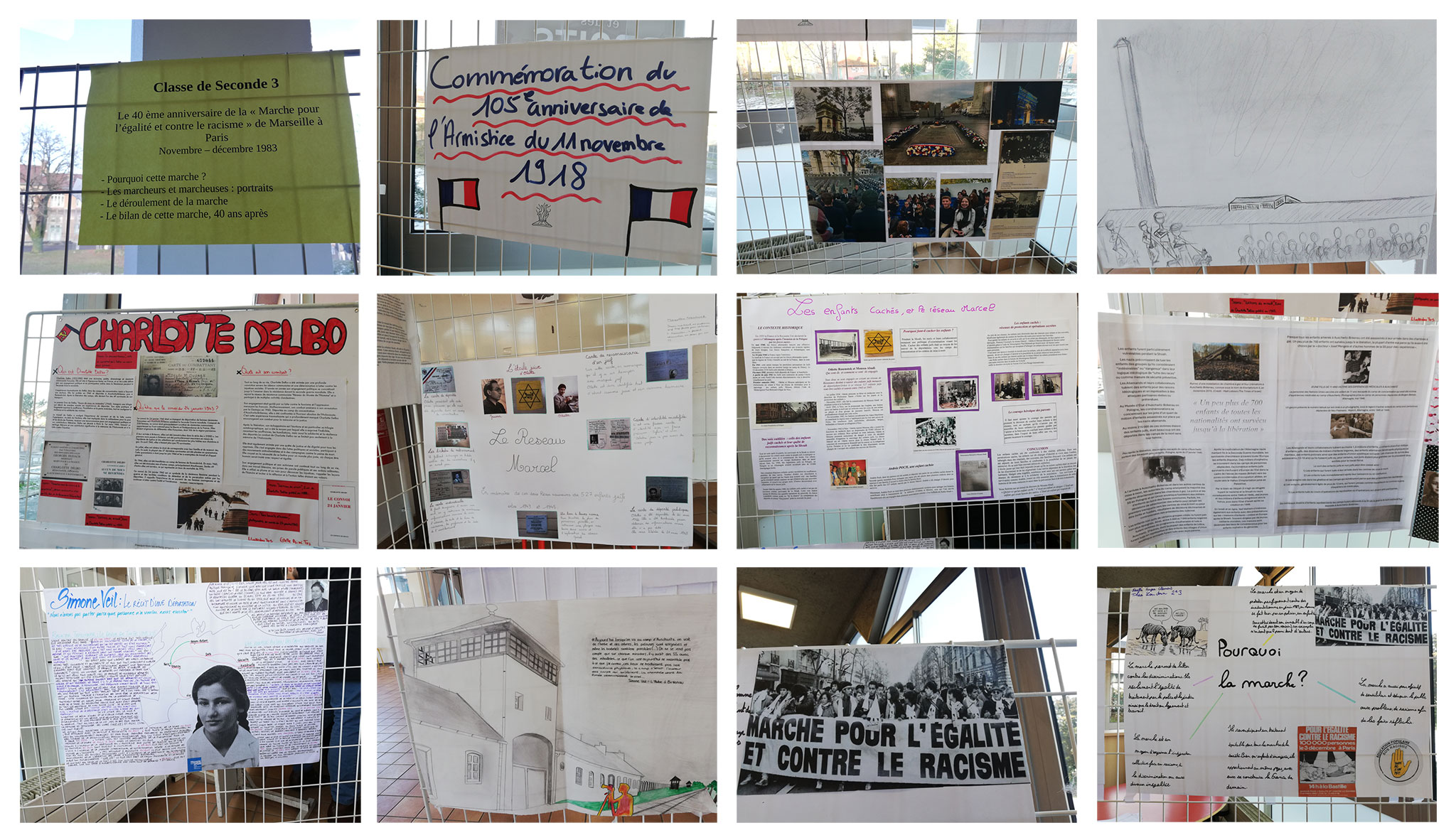
Gabriel Demirdjian of class 1GI treated us to a very moving personal piece:
On this day so charged with History, we are gathered here, united by the fragile silver thread of Memory, of which we are the fervent guardians.
Today we remember the innocent stars fallen from the sky of humanity, who braved the storms of war at every moment and faced death with a courage so powerful that our minds could not even try to feel it, or even imagine it. They are the beacons of hope, whose heroism is and will for ever be engraved in the marble of history.
Today their voices still resound in our hearts, like a poignant echo of their pain. These lives, though broken, are an all-important reminder of the value of peace – a value far too neglected in a world of constant division and destruction.
You know as well as I do that the tragic melody of past wars should no longer resound through our world today. Yet the words of that sinister song, written in the blood of innocents, continue to shake humanity. Millions of lives are still being lost, families are endlessly torn apart and landscapes turned into theatres of desolation, for which Humankind alone is responsible.
Keeping the flame of memory alive in each of us means refusing to see these tragic events repeated, and learning at last from the crimes of the past to forge a future shining with happiness and solidarity. War is only a storm of suffering that we must eradicate, and peace the harbour where we must all seek to land – such must be the only destiny of Humanity…
Thank you.
Gabriel DEMIRDJIAN (1G1)
Moussa’s voice closed this intense hour, carrying the values that we, in our turn, teachers or witnesses, want to try to pass on to the younger generations.
Andrée Poch-Karsenti