Why stones?

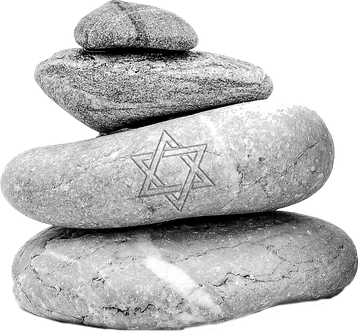
Some will have noticed that the logo of the Enfants et Amis Abadi website shows a pile of stones. Those who look for the meaning of things will have linked it to the Jewish custom of placing stones on the graves of the people one wishes to honour and whose memory one wishes to keep alive. Since one of the association’s aims is to perpetuate the memory of Odette and Moussa Abadi (who died in 1999 and 1997 respectively), the symbol seemed fitting. But where does this tradition come from?
Many versions vie to explain this gesture. It is difficult to determine its exact origin, especially as some explanations very probably arose long after the custom began.
First of all, it should be noted that this tradition exists only among Ashkenazi Jews, who do not lay flowers on graves, unlike Sephardi Jews, for example.
The most common explanation is that in the past the dead were not buried in cemeteries. The place where the “souls” lay therefore had to be marked with stones. Moreover, according to writings from the 3rd century, priests had to avoid making themselves impure by crossing places defiled by corpses. The stones warned them of such places.
Before this first explanation there is another, more ancient one. According to Genesis, Rachel died giving birth to Benjamin, her eleventh child, on the road to Ephrath. Jacob, her husband, raised a monument of stones over her grave. This monument was to serve as a sign of recognition for the children of Israel on the road to exile. Rachel’s Tomb today is a rock topped with eleven stones symbolising her eleven children. It is located next to Bethlehem, in the biblical territory of Judea, in the present-day West Bank.
Other rituals sometimes complement this tradition. It is said that people used to place a blade of grass held down by a stone on the grave. The blade of grass symbolises the decline of the human being. The stone is meant to hold the blade of grass down as long as possible. The grass eventually dies, blows away and disappears. It seems the grass was abandoned and only the stone kept, as a symbol of what holds on (remembrance).
Finally, although it has become customary to leave the small stones on the grave, the complete gesture involves removing them when leaving. Placing the stone is meant to call the soul of the deceased to us for the time of remembrance. Removing it allows the soul to rise again.