
Meeting Gabriel Garran
August 27, 2020
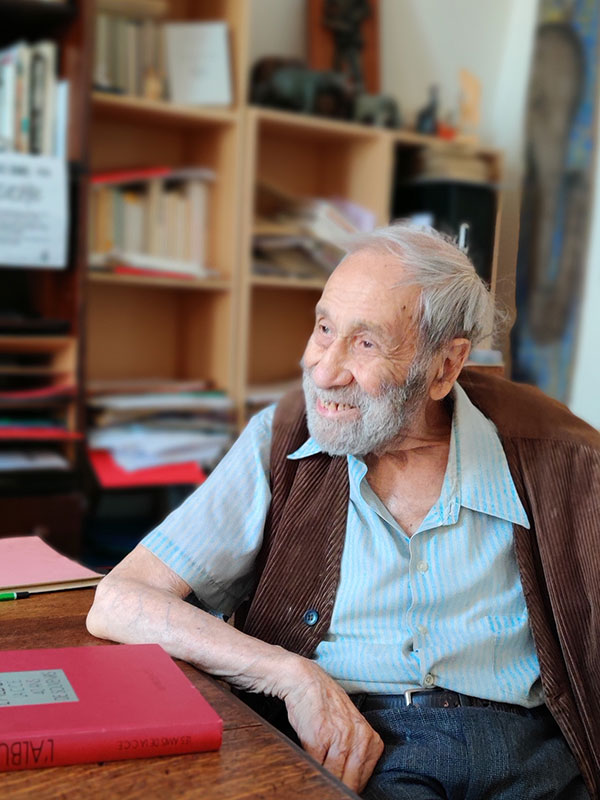
3…4…5… It sounds like a nursery rhyme, but read it as 345 and it is the number of the building where, after going through a small door, I take a cramped passage leading to a staircase with uneven steps, worn by time. Emmanuel is with me, camera in his pocket, ready to draw! We arrive at Gabriel Garran’s home on this Saturday in August, hoping to fill our basket with a few memories to add to our knowledge of Moussa.
Why Gabriel Garran, and who is he? I remembered that when our Association was founded he was an “Abadi Friend”; we met him a few times at our meetings, and after an accident that left him in a coma we never saw him again. Clumsily, we stopped asking after him.
Gabriel is what one might call a great figure of the theatre, and the theatre owes him a great deal – notably the Festival of Dramatic Art in Aubervilliers, where he staged Vishnevsky, Sean O’Casey, August Strindberg and William Shakespeare from 1961 to 1964. During those four years audiences grew so much that the town of Aubervilliers agreed to Gabriel’s request: to create a venue, which took the name “Théâtre de la Commune” on January 25, 1965.
In 1985 he left Aubervilliers and founded the TILF (International French-Language Theatre) at La Villette. He was its director until 2004. He wanted to create a repertoire that gave room to the diversity of the French language around the world. So authors from sub-Saharan Africa, the Maghreb and Quebec were performed on the TILF stage. Meanwhile, from 1959 to 1980, Moussa Abadi produced the radio programme “Images et Visages du théâtre d’aujourd’hui”, broadcast by Radio France Internationale – he too eager to make the actors, directors and poets he interviewed heard throughout the French-speaking world.
Listening that Saturday to the story of a life, I could not help thinking of the similarities between Gabriel Garran and Moussa. Of course, Moussa was nineteen years older, but both had within them that love of theatre, of the actor, of directing and above all of the beauty of the French language. Both had the same desire to see plays by contemporary authors performed (even if Gabriel Garran also drew on the classical repertoire). He staged Arthur Miller, Arthur Adamov, Peter Weiss, etc. In his book “La Comédie du Théâtre”, published in 1985, Moussa lambasts his era for not making room for contemporary authors.
Gabriel was eleven when the Second World War was declared. A pupil at the Lycée Turgot, he was expelled for being Jewish – just as Moussa had to leave the Sorbonne and his studies as a medievalist. Both took the road of exile, but in different circumstances. Gabriel was a hidden child. He tells of his wanderings during the four years of war, separated from his deported father, from his mother and his sister Jeanne (an account he gives in his moving book Géographie française, published in 2014). He crossed the demarcation line on the day the Germans crossed it and went from hiding place to hiding place. He was given another name and experienced this new identity as a fundamental wound. Moussa hid Jewish children, changed their names and, racked with remorse many years later, called himself an “identity thief”, aware of the trauma that had been necessary to save lives.
After the war, Gabriel was sixteen and, as a young youth leader, looked after a group of children in the rue de Paradis. Several options were offered to them, including two groups related to the performing arts: cinema, which he preferred, and theatre, which he considered a 19th-century art, though he had a certain interest in it. Until the day Moussa knocked at his door: “Come on,” he said, “I’m taking you to the theatre!” Together they attended a performance with Maria Casarès at the Théâtre Charles Dullin. He was 19; it was a revelation. Did he feel the same wonder that seized Moussa in 1929 when, wandering into a theatre by chance, he discovered, breathless, the actor Louis Jouvet?
In 1951 Gabriel Garran joined the “Espoir” group, where he was the only one who was not an actor but, in a way, the stage manager. When the director of Chabrol’s “Ma déchirure” pulled out because he was leaving, the company asked Gabriel – the only one not on stage – to give them his comments. It was the very beginning of a career; this was 1951/1952. To perfect his skills, Gabriel enrolled at Tania Balachova’s Vieux-Colombier school, where he very quickly began staging readings. A little flashback? Moussa too staged readings. It was at one of them, on the medieval Fabliaux, initiated by Gustave Cohen in Nice, that he met Monseigneur Rémond, who had come as a spectator.
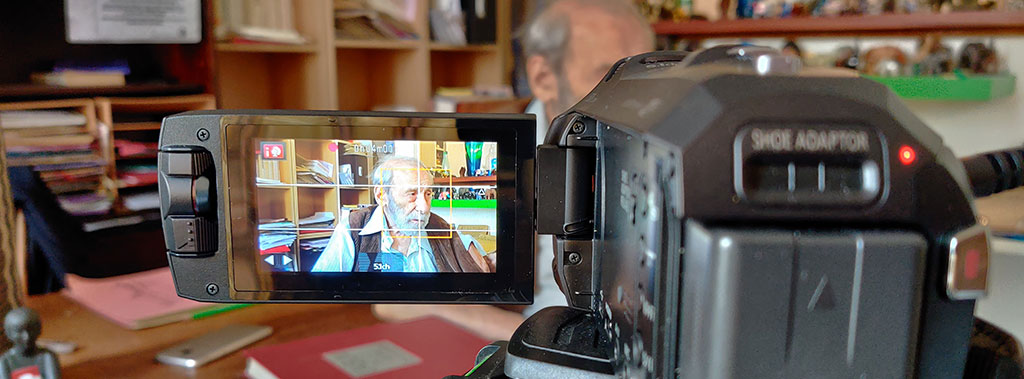
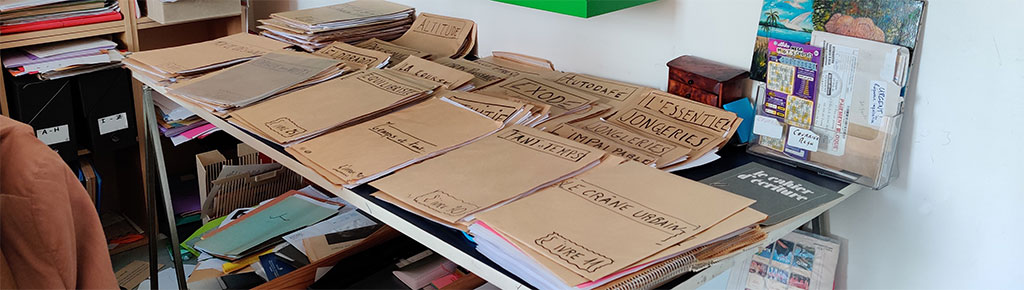
The “345” is like an Aladdin’s cave of theatre! Files are piled up in a precarious balance, fill the shelves and form a guard of honour along the corridor. Gabriel tells his story, offering us his memories, sometimes breaking off, confused by a chronology that plays hide-and-seek with his memory; we are spellbound.
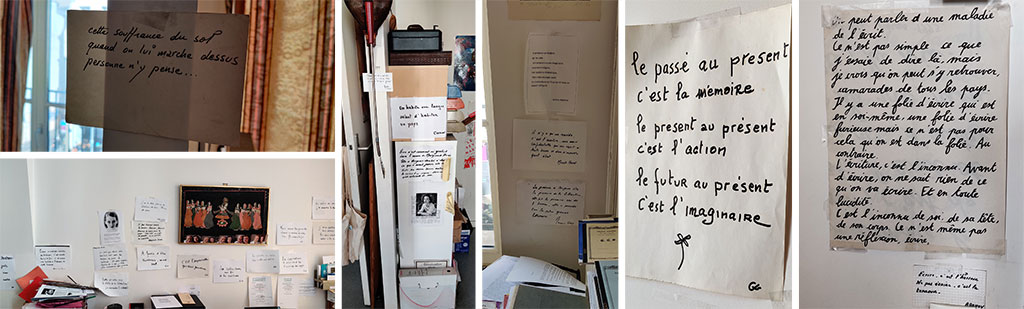
The walls, like a student’s, are covered with sheets of paper on which writers’ quotations answer Gabriel the poet – for he is also a poet. The one that, for me, wonderfully sums up those hours is by Gabriel:
The past in the present is memory
The present in the present is action
The future in the present is imagination
Thank you, Gabriel
Andrée Poch-Karsenti / Emmanuel Gagnier
(August 15, 2020)