
Theatre and Resistance: Depersonalisation & Identity (Monday, June 22, 2009)
Theatre and Resistance: Depersonalisation & Identity (Monday, June 22, 2009)
Report by Jeannette Wolgust (Association Les Enfants et Amis Abadi)


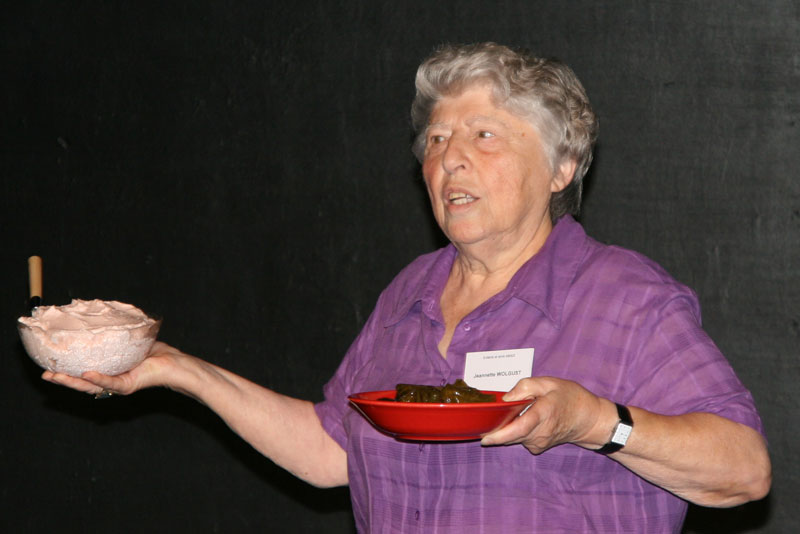


Thanks to the unshakeable determination of Andrée Poch Karsenti, president of Les Enfants et Amis Abadi, and the friendly help of Micheline and Lucien Attoun, directors of the Théâtre Ouvert in Paris, a conference was held on June 22 on the theme “Theatre and Resistance, Odette and Moussa Abadi, depersonalisation and identity”. It was a real success!
Early in the morning the “Abadi children” were there, each at their post, putting the finishing touches to the “set” of the play that was to be performed that day: posters and photographs illustrating the Marcel network, but also the man of the theatre that Moussa Abadi had been. The audience looked at these posters with interest.
From 10 a.m. the hall was full, and the audience was delighted to recognise the many authors who had known Odette and Moussa well: Roland Monod, Jean-Claude Grumberg, Robert Pouderou, Victor Haïm, Lucien Attoun.
Pierre-Emmanuel Dauzat had agreed to play the difficult role of moderator; he diplomatically managed the various speakers and closed the day devoted to Moussa by discussing the place of Odette’s book Terre de Détresse in the literary world.
Catherine Jourdan, a philosophy agrégée, knew Moussa and Odette well. A true piece of academic work, her account of life in Nice during the war was a tribute to the couple. The actor Vincent Daufin read the texts by authors she quoted.
Then Andrée Poch-Karsenti presented the life of Moussa Abadi, a man of culture, in love with the theatre, an actor, critic and radio columnist. With great intensity and emotion she presented the Resister who saved so many children, giving the floor to her daughter Natacha to read the texts illustrating her subject – a very moving duo and a beautiful picture of harmony between mother and daughter.
Next came interviews with Ariane Mnouchkine and Patrice Chéreau by Lucien Attoun.
At the end of the morning, all the theatre people came on stage and each of them, with humour, pleasure and volubility, told of their relationship with Moussa.
After the lunch break, Helen Solterer, professor of French at Duke University, USA, presented a very thorough and most interesting piece of work on the theme: “Did dramatic play help the Marcel network in its clandestine work with the hidden children?”
Then Natacha Karsenti read a poem by Charlotte Delbo.
Charif Kiwan, a columnist and editor at a Lebanese daily, raised the question of a different reading of Moussa Abadi’s book “La Reine et le calligraphe”. The journalist stressed Moussa’s universality – he came from the ghetto of Damascus, where he grew up, to become a man of letters and of the theatre in France.
Maria Landau, a neuropsychiatrist and psychoanalyst, discussed the trauma of the Jewish children hidden during the war, who had undergone “depersonalisation”, forced to change identity and learn a new one, fearing they would give away the secret of this new name they found hard to make their own. Maria also presented Odette Abadi’s book “Terre de détresse”: 50 years after her return, Odette wrote one of the finest books on deportation, suffering and brotherhood, despair and hope! It is all there!
Natacha Karsenti read an extract from the book.
Victor Haïm read “La malédiction” (The curse), from Moussa Abadi’s book “La Reine et le Calligraphe”. Exceptional! For a quarter of an hour, the audience hung on his every word.
Pierre-Emmanuel Dauzat invited the “Abadi children” in the audience on stage, and they gathered around Maria Landau: Andrée Poch Karsenti, Marthe Kuperminc, Eve Schmidt, Armand Morgensztern, Estelle Amar, Armand Kac, Pierre Loeb, Julien Engel, Jeannette Wolgust. Each told of their time in the Marcel network. A moment of great intensity! I had the impression that we, the children, were holding hands to comfort each other. Odette and Moussa were present at the centre of this fraternal circle. Some were unable to speak, overcome by emotion. It was the only moment when the audience asked questions.
During the debate with the audience, Georges Loinger spoke. A great Resister, responsible for getting several hundred children into Switzerland, he spoke of his work during the war and of the children’s anguish when he left them to go back to France to fetch others. The audience and participants, moved to see him sitting among the spectators, gave him a standing ovation. Victor Kuperminc pointed out his great age and great intelligence. Lucien Attoun expressed the wish to hold a day in his honour next year, for his hundredth birthday.
To conclude, Pierre-Emmanuel Dauzat gave the floor to Andrée Poch Karsenti and Lucien Attoun. Andrée thanked everyone for taking part and making this conference a success. She did exceptional work, which allowed us to recall, with warmth and sincerity, Odette and Moussa Abadi, to whom so many children owe their lives.
It was a hard day for all of us!
Thank you to Andrée, to Lucien and to everyone!
Jeannette Wolgust
Back to the main article
Report on the conference by Robert Pouderou
The Marcel network, or the Comedy of the Theatre, according to Victor Kuperminc