
Beit Project – days of November 9 and 12, 2020
March 11, 2021
On Thursday, March 18 at 6 p.m., the Beit Project will present its Paris 2020 project online. The direct link to join the presentation:

(open access, no need to be registered on Facebook)
Presentation by Andrée Poch-Karsenti
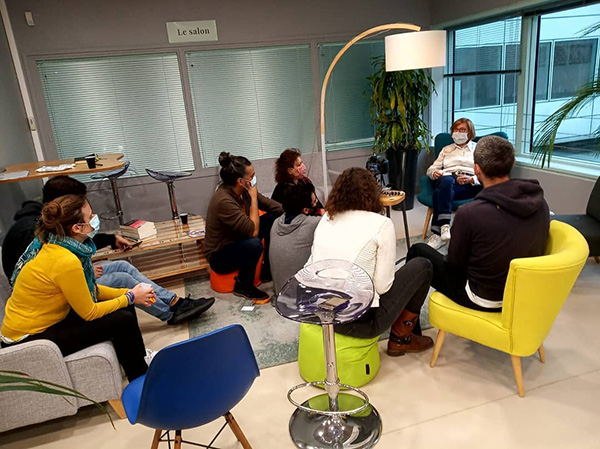
The Beit Project? It is a European project: “the concept is to set up a ‘nomadic classroom’ in a place rich in traces of the past, recent or distant. For two days per group, pupils from two very different schools get to know each other and learn to work together. Around an ephemeral, nomadic school, they make a neighbourhood their own, working on traces of the past, social issues and video-making. The key idea of the project is to use the city and its history to debate the major contemporary issues of living together and fighting discrimination, in order to build a common future. It aims to make young people aware of plurality and cultural diversity through discovering and interpreting heritage sites linked to the history, distant or recent, of their city.”
That is how David Stoleru, who created this concept, described his project to me. For some years now, the Beit has gradually come closer to the story of Odette and Moussa: in 2017 around the 10th and 12th arrondissements of Paris, in March 2018 in Nice, and in November 2020 with pupils from the Collège Albert Schweitzer in Créteil in partnership with the Collège Sainte-Élisabeth in the 15th arrondissement of Paris. I had the great pleasure of taking part in a day in November with the Créteil pupils.
Lockdown did not allow these pupils to go to the 15th, nor those from that arrondissement to explore Créteil, but the two schools exchanged videos to explore, among other places, the traces of the Vel d’Hiv, the Eiffel Tower and the banner “Here we drown Algerians”. Divided into several groups, the pupils were able to consult many documents on the subjects they chose and move around the whole school, questioning in turn the library staff, a history teacher, an administrator… Turning into camera operators, they filmed and enjoyed being able to use a camera; I also answered their questions.
Andrée Poch-Karsenti
Programme of the video presentation on March 18, 6 p.m.
Schools taking part in the project:
Collège Schweitzer (Year 9 E and Year 9 D)
Collège Sainte-Élisabeth (Year 8 )
Collège MHS (Year 7 and Year 8 )
Part 1 (6 p.m.): Introduction to the project – screening of the making-of
Welcome
Address by the founder/director, David Stoleru: origins of the project, ambitions
Introduction to the project and its specific features (neighbourhood, venue…), the participating schools, local partners and facilitators
Presentation and screening of the making-of
Presentation and address by Andrée Poch: her experience of the project
Part 2: Presentation of the films
Introduction to the films
Screening of the films: 6 videos.
Facilitators speak: why take part in this project? Why is it in tune with its time?
Teachers speak
Young people speak.
Questions from the audience
Conclusion