Letter from Madame Zola: A family commitment
October 31, 2022
When Odette died in 1997, those close to her, including our president Andrée Poch-Karsenti, recovered many documents that Odette had carefully kept. Odette and Moussa Abadi thus left us a good number of archive documents (index cards, letters, photos…). Many of these documents have been entrusted to the Mémorial de la Shoah, others to the BnF, and others have remained with some of the hidden children – Andrée, Jeannette, Marthoune…
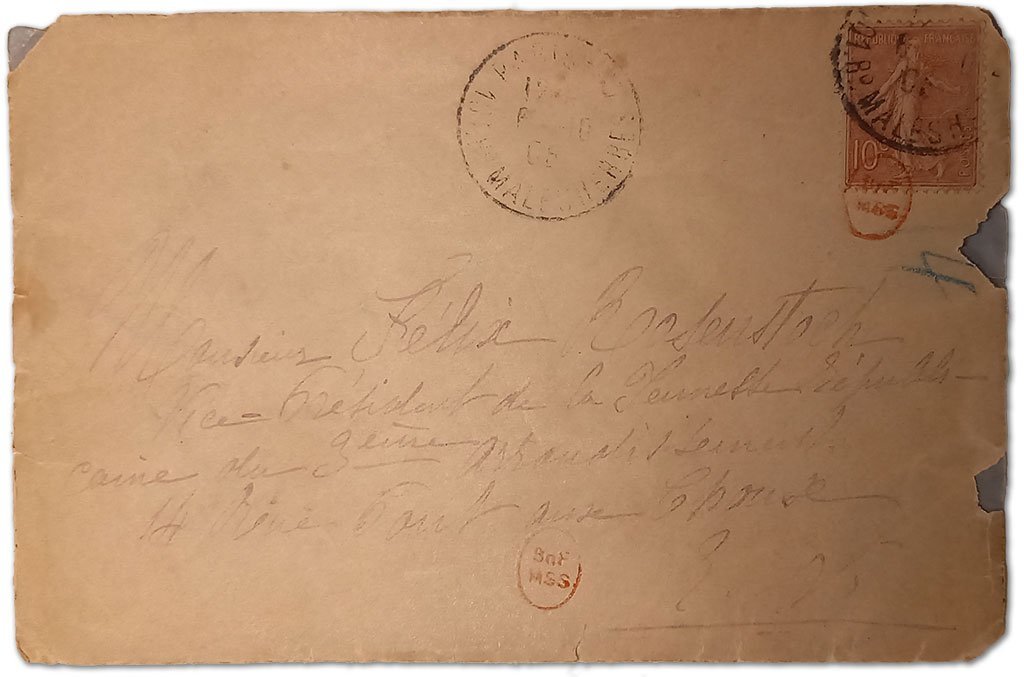
Recently, while sorting through some papers, Andrée Poch-Karsenti came across a letter signed by Alexandrine Zola, the wife of Émile Zola.
This letter, dated October 5, 1906, is addressed to Félix Rosenstock, Odette’s uncle. A shopkeeper, he was involved in the Jeunesses Républicaines (JR) movement. It was in 1906 that Captain Dreyfus was rehabilitated in the infamous affair that bears his name (1). The Jeunesses Républicaines regularly organised lectures. Félix Rosenstock had evidently taken care to reserve a seat for Madame Zola at one of them, at which her husband’s memory was honoured, and had let her know. The letter found and presented here is Madame Zola’s letter thanking Félix Rosenstock for this kind gesture.
October 5, 1906,
Sir,
I have known for some days, through our very dear Maurice Le Blanc, of the lecture being organised by the Jeunesse Républicaine of the third arrondissement. And this very day I was asking this friend how I should go about obtaining a few seats. He told me he would give me an answer shortly. That tells you, Sir, how keen I was to attend this lecture even before you were kind enough to invite me. I am therefore very happy that our ideas are the same. In that case, nothing is easier than to agree.
It remains for me to ask you to be my interpreter to these young republicans, to tell them how touched I am by the tribute they are paying to my very dear husband, and to convey to them my deepest gratitude.
Please accept, Sir, the assurance of my deeply moved sentiments.
Alexandrine Zola
This letter, now kept at the BnF, no doubt bears witness to the family’s commitment to fighting antisemitism openly.
In his day, Félix Rosenstock worked for the memory of Émile Zola and his commitment in the Dreyfus affair. A few years later, his niece Odette went to the Pyrenees to welcome the Spanish Republican refugees from the war. She took part in several clandestine actions, getting refugees out of the camp in ambulances, directing them to hospitals and giving them first aid. Then she created the Marcel network with Moussa Abadi and thus helped save 527 children whom Nazi antisemitism had destined for certain death.
(1) The Dreyfus affair divided France, and Émile Zola distinguished himself in this struggle with an open letter to the President of the Republic entitled “J’accuse”, published in issue 87 of the newspaper L’Aurore on January 13, 1898. The fratricidal struggle that divided France during the Dreyfus affair from 1894 led many left-wing figures to rally to Émile Zola’s manifesto and created a ferment that gave rise to many youth movements. In 1902, two identical movements proposing to undertake the same actions came into being almost simultaneously: the Jeunesses Laïques (JL), provincial in origin but with a national reach, and the Jeunesses Républicaines (JR), based mainly in Paris. Both attached to freedom of conscience and respect for all convictions, they upheld the superiority of secular morality. On the social front, they took up the struggle in the name of justice, well-being and everything that made up the honour and joy of living. After the First World War, since nothing – or almost nothing – distinguished them, they decided to merge on April 6, 1924 to seal their common aspirations. The Federation of Jeunesses Laïques et Républicaines was then created. The JLR adopted the JL motto, “Beauty, Truth, Justice”, as well as their statutes. The JLR placed at their head honorary presidents whose moral worth and elevation of thought honour humanity. Four of them belong to France’s intellectual heritage: Émile ZOLA (1900–1902), Anatole FRANCE (1903–1924), Lucien Victor MEUNIER (1925–1930) and Georges BOUCOIRAN (1931–1962).