
Victor KUPERMINC
July 19, 2021
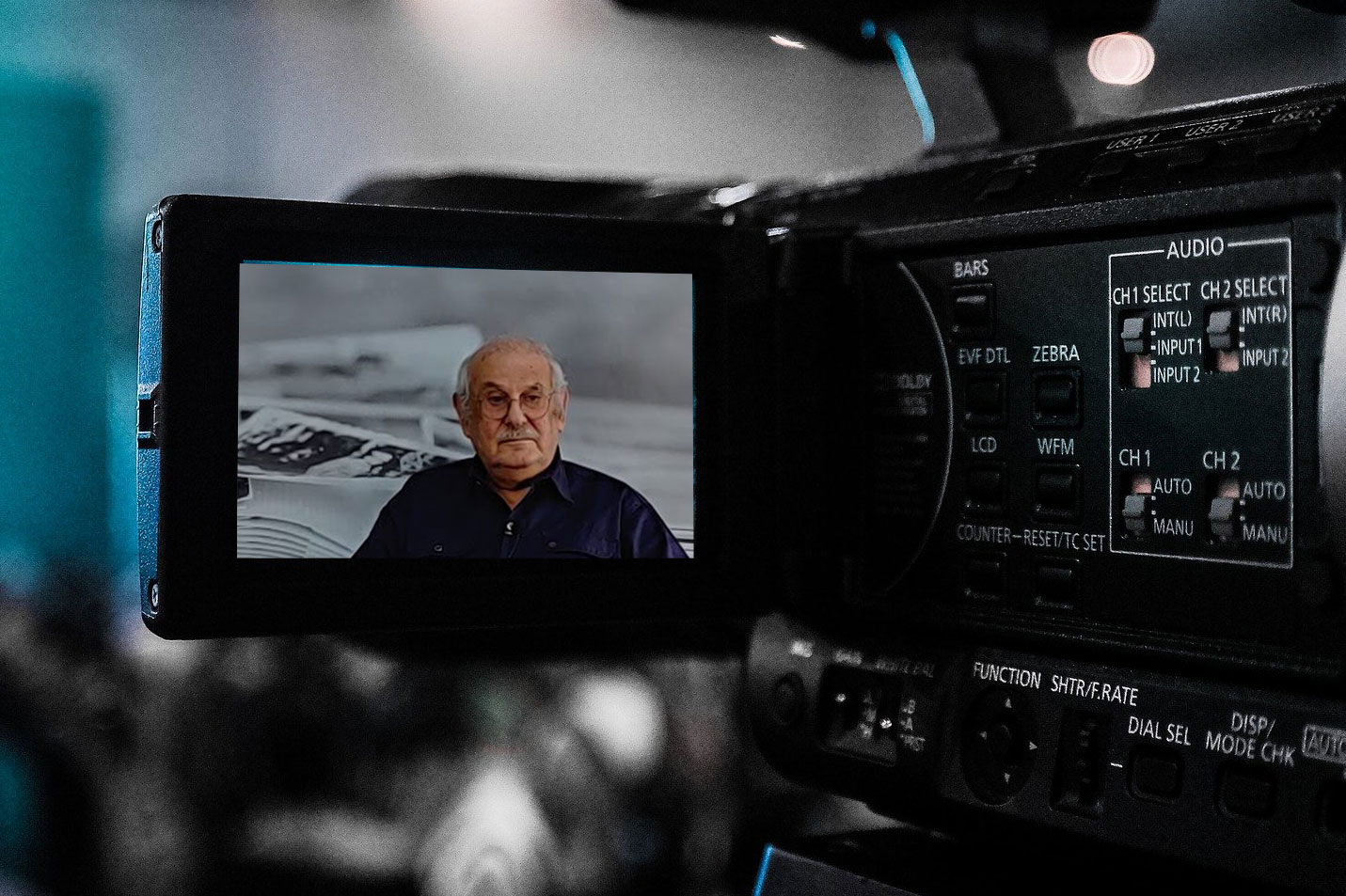 Victor Kuperminc is not, strictly speaking, a hidden child. But he is a Friend of the Abadis and has always been our association’s treasurer; above all, he shares his life with Marthe, who was a hidden child and has already told her story in our collection “Histoires du Réseau Marcel”. Victor’s story during the occupation is nonetheless exceptional too.
We went to record Victor at his home, and it is with great emotion that he shares his story with us today.
1925: Abram KUPERMINC, a young man of 29, leaves the small town of PRZEDBÓRZ, a shtetl 150 km south of Warsaw on the Pilica river, a tributary of the Vistula. He kisses his wife Rachel, his daughter Fanny and his son Benjamin, aged 5 and 3, goodbye.
He crosses Europe, bound for Paris, in France, where his wife and children will join him later, as soon as he has found work as a men’s tailor. The aim is to raise the money for the boat that will take them to America, where his elder brother has been living for several years and is making his fortune, or so he says.
In Paris he is taken in by Simon LEWKOVICZ, his brother-in-law, who gives him a leg up – in other words, a sewing machine. In 1927, he finds Rachel on the doorstep, with their daughter Fanny and their son Benjamin. Rachel, too, has crossed Europe, speaking and understanding only Yiddish, unable to read or write – only the boys went to the “heder”, the Jewish school. Abram and Rachel settle in the “Pletzl”, the Ashkenazi quarter of Paris, in a building with every modern convenience: windows onto the courtyard, the kitchen tap serving as the bathroom, and the toilets on the staircase!
Abram works hard; he now has his own workshop. Rachel has given him three sons, in 1927, 1929 and 1933: Maurice, Simon and Victor. The sons will go to the workshop after their primary school certificate. No more school. What for? To become a doctor? Why not a rabbi? The youngest will be luckier: he will go to the lycée, thanks to his brothers and sister. And there is no more room in the workshop anyway!
May 25, 1940. This is the date of the official document headed “République Française – Liberté, Égalité, Fraternité”, signed by Albert Lebrun and his Minister of Justice, Albert Sérol, which states: “The following are naturalised French:
KUPERMINC Abram, tailor, with 2 minor children
Fajla (Fanny)
Benjamin Salomon
and LEWKOWICZ Ruchla, his wife.”
Three weeks later, the Wehrmacht marches down the Champs-Élysées. And within a month, the French State wrings the neck of the Republic.
Then came those four terrible years that we would rather erase from our memories.
From June 1940 to May 1944, Abram is placed under “Aryan management”, and is obliged to put up the poster “JÜDISCHES GESCHÄFT” (Jewish business) on the door of the family flat.
Extract from the reports of the 6 Aryan managers:
I visited this business, where I met M. Kuperminc Abraham, Polish, naturalised French on May 25, 1940. It is a very small craft business. He is a tailor, a jobbing craftsman, and has no contact with customers. His premises consist of 3 small rooms, which also serve as his home. I have personally established that he has no equipment, no workers and no stock of goods.
I propose that he be authorised to continue his craft activity.
Another report:
This Jew meets the conditions required by the G.A. (German Authorities). He has no private customers and works alone for the firm FASHIONABLE, 16 boulevard Montmartre. He has been struck off the Trade Register. His buyer’s card has been withdrawn.
I ask the G.A. to recognise the status of the Jew KUPERMINC as a jobbing worker and to relieve the provisional administrator, M. MAGNIER.
And on May 15, 1944, Les Ateliers St Fiacre, Paris, send the CGQJ (General Commissariat for Jewish Affairs) a certificate:
I, the undersigned, BRACCHI Joseph, manager, certify that I employ M. Kuperminc Abraham, living at 55 rue au Maire, Paris, as a home-based piece worker.
June 1942: the obligation to wear the yellow star, sewn on the left side of the chest. Abram had gone to queue at the police station in rue de Bretagne to collect the stars (3 per person) in exchange for one point from the “textile” ration card. 3 stars were worth a pair of socks.
Victor wore it at the primary school in rue Saint-Martin, as did the very few little Jews of the 3rd arrondissement still in Paris. Even when the teachers made him sing “Maréchal, nous voilà !”. People had their photos taken – a misplaced pride. They could not have known. His resistance was to be top of the class – witness the prize for excellence of 1943, a Jules Verne from the “Bibliothèque Verte”.
Fanny, the eldest, was now married and lived in the 20th arrondissement, far from the Arts-et-Métiers district.
The only entertainment was taking the metro to Bagnolet. Except in the last carriage, because Jews were required to travel in it. No question of wearing the star there. The solution was to hide the absence of the star with a book, to make people think it was there. The neighbours were not fooled by this fragile ploy, and looked the other way.
Rachel, often helped by one of the boys, did the shopping at the local shops between 3 and 4 p.m., when there was nothing (or almost nothing) left. A husband and three sons had to be fed. How did she do it? A mystery. Bartering was treated as black-marketeering, which was very dangerous, especially for a Jewish family. They got by.
Adèle Katz was the workshop’s finisher. Her husband, whom no one had ever seen, had been caught in the very first round-up, the so-called “green ticket” round-up. Adèle was a tall, beautiful young woman, alone and without resources. She was burdened with a son, Willy, a big simpleton with the mental age of a child under ten. He came to the workshop once or twice, then was never seen again. Maurice, the big brother, rather eyed Adèle and whispered to Simon comments on what he had glimpsed or thought he had glimpsed. And the two brothers would get rid of Victor, who would have liked to be let in on the secret.
One morning, Adèle, later than usual, pushed open the door, followed by a stranger – tall, slim, impeccable, but in a field-grey uniform.
“Oy,” said Abram. “Oy oy oy!” said Rachel!
“This is Ludwig,” Adèle introduced him. She opened a black canvas bag containing a field-grey coat. “He would like it altered to fit him. You have nothing to fear – he’ll pay!”
She explained: “Ludwig is maître d’hôtel at the Hôtel Margerie, on the Grands Boulevards. It’s the restaurant for German officers. He comes from Luxembourg; he has a restaurant there. He was forcibly conscripted, he is very kind, and he speaks French.”
The coat was altered. No one ever knew whether Ludwig paid. But from that day on, the bread was almost fresh, and almost white.
And it was at this time that the night-time expeditions began. As soon as night fell, Abram gathered his little world – his wife, his sons and the head of the sewing machine, everything that was precious. And they went to sleep on the 5th floor, at the Gelmans’, the neighbours whose flat had been empty for a few weeks. They broke the seals, pushed open the unlocked door and carefully closed it again. Not a word; they walked in slippers and held their breath. And early in the morning they went back home to the 3rd floor.
There were four or five Jewish families in the building. Only the Kuperminc family was still there. Where had all those people gone? Rumours circulated. To the free zone, to a labour camp in the East, to America?
And life went on. Abram and Maurice in the workshop. The eldest son, Benjamin, had left at the beginning of the occupation for the free zone, in the Dordogne, to resist, in the land of foie gras. He wrote, but rarely. Fanny, her husband Robert and little Claire, born in 1942, near the Bagnolet metro station. Simon and Victor at the school in rue Saint-Martin. And Rachel in the kitchen, of course.
They lived frugally, kept a low profile, avoided attention, did everything they were told to do and nothing they were forbidden to do, well aware of this strange situation that could tip over at any moment.
Abram and Rachel kept up a semblance of Jewish life. For the Passover Seder, a board was set up on two trestles in the boys’ room – in reality, a windowless corridor. Abram read – or rather whispered – the story of our ancestors’ deliverance from Egypt from his old book, stained with red wine, brought from Poland. And out came the “matzot”, which had a very strange taste: the unleavened bread, stored in the cupboard, was impregnated with the mothballs meant to protect the family treasure, a few lengths of cloth from Roubaix.
In fine weather, and at the permitted times, they went for walks where it was not forbidden: the banks of the Seine, pedestrian in those days. They would meet the few families who were surviving in Paris. And one day, Uncle Simon Lewkovitz was no longer to be seen: he had been caught in a round-up. The uncle, French long before the Kuperminc family, was a personality in this small Jewish world. It was said he had connections and could help you if you had problems with the authorities.
August 1944. At last came the hour of the Liberation. The yellow stars were quickly removed and thrown in the bin. The “Boches” were more and more nervous, the FFI (French Forces of the Interior) more and more numerous. A barricade had sprung up at the corner of rue au Maire and rue de Turbigo. The local kids ran everywhere carrying an old mattress, bits of anything at all, as long as it stopped the vehicles with the Maltese cross from getting through. The big boys left early in the morning and came back late at night. Apparently they were going to join cousin Lucien, who was something in the Resistance. The first thing Victor did, to assert his newfound freedom, was to go down into the street and put on his roller skates, hidden far under the bed for a long time. He too liberated Paris. Two or three FFI men were defending the barricade. One of them, armed with a rifle that had been through 1914–18, was aiming at the bell tower of Saint-Nicolas-des-Champs, where a collaborator was hiding. Victor handed him the bullets he took from the leather satchel. Each time a bullet hit the sirens with a pretty “ding”, the crowd applauded.
One evening, Ludwig came back to the house in his shirtsleeves and field-grey uniform trousers. Now it was he who was keeping close to the walls. He shut himself in the workshop with the parents for a long time. Ludwig came out wearing a light grey suit, visibly too small for his big frame. The goodbyes were quickly over: a handshake for Dad and the big boys, a furtive kiss on Mum’s hand. Victor was lifted off the ground, with a big kiss on each cheek. Exit our “good German”.
A few days later, Victor caught his brothers rummaging through the box where the lining offcuts were kept. They ordered him to keep quiet. Maurice pulled out a field-grey bundle. It was the uniform, wrapped around a dark, heavy object: Ludwig’s officer’s pistol. A “Luger”, diagnosed the big brother, who knew about such things – an avid reader of “Science et Vie”. Everyone wanted to hold the weapon, even the little brother. And in the days that followed, the whole treasure disappeared. No questions were asked of Abram.
More than a year later, a letter arrived from Adèle, with a Chicago stamp. She said she had joined her husband’s family. She asked them to contact Ludwig in Luxembourg.
Not to tell him to come and join her. No – to ask him to stay at home; she had probably started a new life over there.
And they never heard from either of them again.